Jean-Luc Demaret G
« A perfect family day on the Semois. The welcome at Kayak Semois Ardenne is warm, the equipment is spotless (the kayaks are modern and clean), and the free shuttle system is superbly organised. A must-visit in the Ardennes! »
Benedictine Heritage, Gastronomic Tradition & the Silence of the Molignée
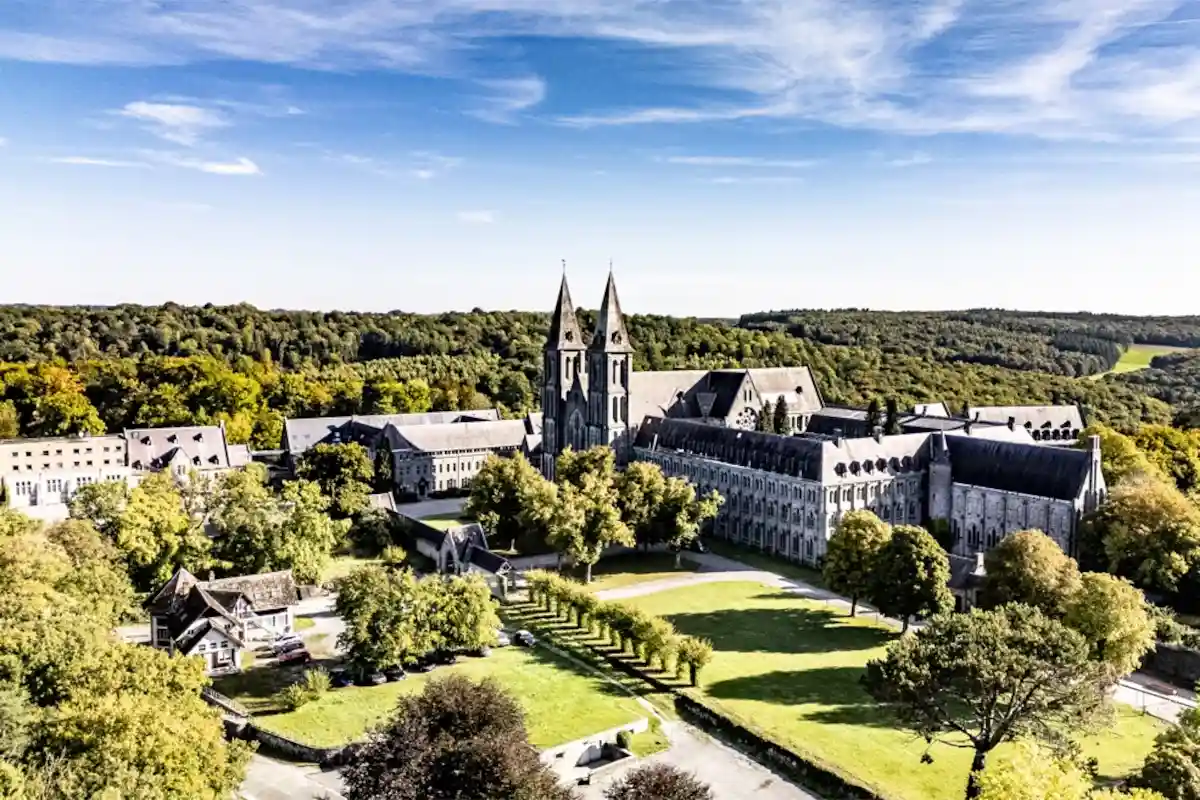
Set in the verdant valley of the Molignée, in the province of Namur, Maredsous Abbey stands as one of the most iconic monastic sites in Northern Europe. Founded in 1872 by the Desclée family, at the instigation of monks from Beuron Abbey in Germany, it embodies the revival of Benedictine monasticism in the 19th century.
It is not merely a place of prayer — it is a crossroads where history, neo-Gothic architecture and the pleasures of the table converge to offer a unique experience to more than 400,000 visitors each year. Whether you seek spirituality, love art or are a discerning foodie, Maredsous opens its doors with the traditional hospitality of the sons of Saint Benedict.
The name "Maredsous" has complex etymological roots, blending Old French and local influences. It is thought to evoke a "mare" (pond) or wetland situated "below" or near a plateau. Geologically, the abbey is built on a foundation of Carboniferous limestone, typical of the Condroz region. This stone, quarried locally from the Molignée valley, has a characteristic blue-grey hue that gives the building its robustness and timeless appearance.
The valley itself is a remarkable example of an incised meander, sculpted over millennia by the small Molignée river. This particular topography provided the isolation essential to monastic life while offering natural resources — water, stone, wood — vital for constructing a complex of this scale. The orientation of the abbey church was designed to capture south-eastern light, symbolising resurrection, while shielding the cloister from prevailing winds.
The history of Maredsous is inseparable from the Desclée family, wealthy industrialists and publishers from Tournai. Deeply devout, brothers Henri and Jules Desclée wished to found a monastery that would serve as a centre of intellectual and spiritual influence. In 1872, they turned to the monks of Beuron (Germany), who were seeking refuge following Bismarck's "Kulturkampf".
The foundation stone was laid on 3 September 1872. This construction project was one of the largest in Belgium at the time. Under the leadership of Father Hildebrand de Hemptinne, who would become the second abbot, the community grew rapidly. By 1878, Maredsous became an autonomous abbey within the Beuron congregation, before heading its own Belgian congregation in 1920. The abbey played a leading role in the modern liturgical movement, particularly through figures such as Dom Columba Marmion, the third abbot, beatified in 2000 for the worldwide influence of his spiritual writings.
Expert note: Maredsous Abbey is a fascinating example of how a religious institution can become a local economic driver while preserving its spiritual integrity. It is a "lieu de mémoire" that engages with modernity — a true cultural beacon for all of Wallonia.
From the first stone laid by the Desclée family to the international influence of its scholarly monks.
The Desclée family finances the construction of the abbey on inherited land. The first monks arrive from Germany.
The monumental abbey church is consecrated. It becomes the beating heart of the community.
Launch of artisan Maredsous cheese production, using a monastic recipe aged in the abbey's cellars.
Commercial sales of Maredsous beer begin, later entrusted to the Duvel Moortgat brewery while remaining under strict monastic supervision.
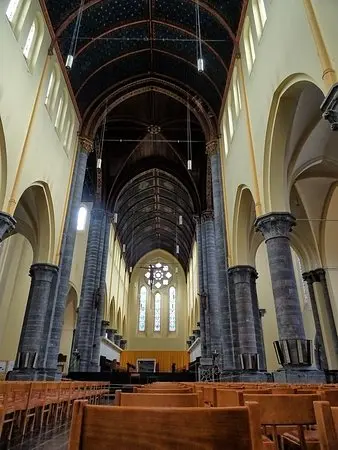
The architecture of Maredsous is the masterly work of Baron Jean-Baptiste Bethune, considered the leading figure of the neo-Gothic movement in Belgium. Unlike other abbeys rebuilt on medieval remains, Maredsous was conceived ex nihilo, resulting in a rare stylistic and structural coherence. The building embodies the medieval ideal reimagined by the 19th century: a pursuit of verticality, light filtered through stained glass and authenticity of materials.
The abbey church, with its two massive square towers rising more than 80 metres, evokes the grandeur of Rhenish cathedrals. Its 78-metre nave impresses with its sobriety and stripped-back simplicity, naturally inviting contemplation. The choice of Molignée limestone is not merely aesthetic; it anchors the abbey in its terroir, giving it the appearance of a spiritual fortress that seems to have always stood among the woods.
The abbey complex is organised around three inner courtyards, including the great cloister, the true nerve centre of community life. Every detail — from the ironwork on the doors to the carved capitals — was designed by Bethune to create a "total work of art" (Gesamtkunstwerk) in the service of the sacred.
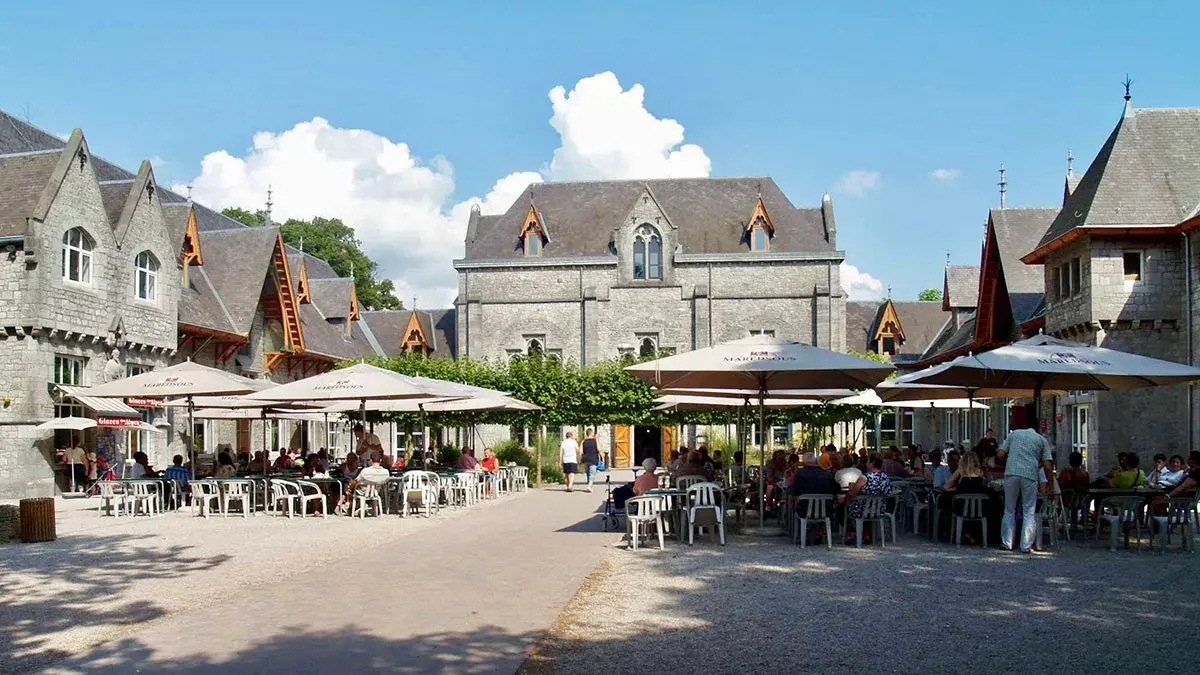
Beyond its stones, Maredsous is a living community of monks who follow the Rule of Saint Benedict, written in the 6th century. This rule rests on two fundamental pillars: Ora et Labora (Pray and Work). The monk's day is structured around the Opus Dei (the Work of God), the sung offices that resound in the abbey church seven times a day, from dawn onwards.
Monastic life at Maredsous is not limited to prayer. It encompasses a strong commitment to intellectual work, teaching (through the college and the former school of craft arts) and welcoming guests. Hospitality is a core value: "All guests who arrive shall be received as Christ", the Rule stipulates. This openness manifests today in the welcome of thousands of visitors, as well as the monastic guesthouse offering retreats in silence.
The abbey is also a world-renowned centre for liturgical research. As early as 1884 it published the "Missel des Fidèles", which allowed laypeople to follow the Mass more actively — anticipating the reforms of Vatican II by several decades. This desire for sharing and education remains the community's driving force in 2026.
Resident monks
Visitors / year
Year of foundation
Tower height
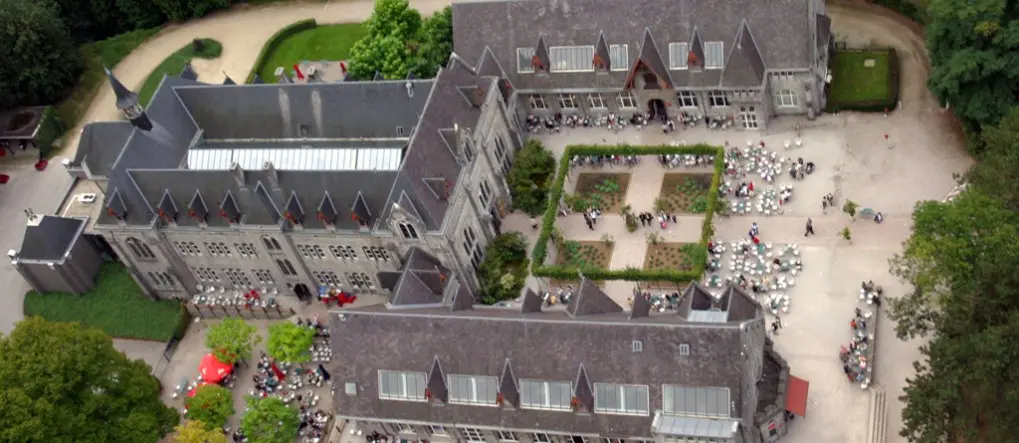
Maredsous cheese is far more than a simple consumer product — it is a technical heritage. Aged in the abbey's cellars, where a constant humidity of 95% and a temperature of 12°C prevail, it develops a unique bacterial flora.
The process relies on regularly brushing the wheels with a saline solution, which encourages the growth of its celebrated natural orange rind. By 2026, the range has expanded: from the Tradition (mild and creamy) to the Fagotin, through to the Caractère (aged longer for greater aromatic intensity). It is an uncooked pressed cheese whose suppleness is its signature.
Although production has been relocated to meet worldwide demand, Maredsous beer remains under the strict supervision of the community. The Maredsous 6 (Blonde) is an approachable, balanced and refreshing beer.
The Maredsous 8 (Brune) offers notes of caramel and dried fruit, while the prestigious Maredsous 10 (Triple) stands out for its aromatic complexity, spicy hints and smooth finish. Served at an ideal temperature of 6 to 10°C in their iconic chalice, they represent the pinnacle of the Belgian abbey brewing tradition.
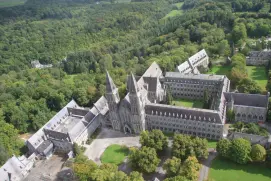
Established by the monks to channel the flow of visitors without disturbing the enclosure, the Saint Joseph Centre is a model for managing a heritage site. Guests can enjoy the "abbey tartine" — artisan grey bread generously topped with Maredsous cheese, often accompanied by premium Ardennes ham.
The centre also houses a shop offering products from other monasteries (jams, honeys, crafts) as well as religious and cultural books. It is the ideal starting point for understanding the Maredsous ecosystem before venturing into the valley.
By Quentin Deligne, Heritage & Tourism Expert
"Maredsous Abbey represents what I call entrepreneurial monasticism. Unlike other sites that withdraw into isolation, Maredsous has built a strong brand synonymous with quality and local produce. For the Haute-Meuse and Molignée region, it is a major attraction. However, the challenge for 2026 is managing this flow of 400,000 visitors while maintaining the silence and serenity of the valley. The integration of the RAVeL network and soft mobility options is an intelligent response to the car-driven overtourism we sometimes observe at weekends. It is a fragile but exemplary balance."
Sustainability index: 8.5/10 | Local impact: Major
The Molignée valley is a protected area classified as Natura 2000. Here you can spot the White-throated Dipper, a small brown bird that "walks" along the riverbed — a sign of excellent water quality. The limestone flora on the slopes also shelters rare wild orchid species, such as the Early Purple Orchid, which blooms in spring.
The abbey is open year-round, offering a different face in each season: from winter frost on the stone towers to the explosion of spring greenery.
Access: Ideally located 20 minutes from Dinant and 30 minutes from Namur. Free on-site parking available.
Guided tours: A must for access to the inner gardens and small monastic museum. Register at the Saint Joseph Centre.
Soft mobility: The abbey is a major relay point for RAVeL cyclists. Electric bike charging points are installed near the cafeteria.
For those wishing to combine heritage with physical activity, several walking loops depart from the main entrance:
Did you know? The Molignée Rail Bikes use an old railway line (line 150) that once carried coal and passengers. Today, your legs provide the engine to explore the valley on rails — an unusual and very popular activity.
Maintaining a complex of Maredsous's scale is a permanent engineering challenge. With more than 15,000 m² of natural slate roofing, the abbey requires constant monitoring. In 2026, structural consolidation works were undertaken on the north tower, using cutting-edge techniques combining resin injections with respect for traditional hydraulic lime mortars.
The thermal management of the buildings is also a subject of ongoing research for heritage experts. How do you insulate walls more than a metre thick without altering the breathability of the blue stone? Innovative solutions, such as hemp-based thermal correction renders, are currently being tested in certain wings of the cloister. This technical expertise, shared with master craftsmen and listed-building architects, makes Maredsous a living laboratory for monumental conservation in Belgium.
Ageing (Affinage): The maturation period for cheese in the cellar, during which it develops its aromas through the action of micro-organisms specific to the abbey.
Beatification: A declaration by which the Pope inscribes someone among the Blessed (e.g. Dom Marmion).
Enclosure (Clôture): The part of the monastery reserved exclusively for monks, closed to the public to guarantee silence and prayer.
Liturgist: An expert in the science of religious ceremonies and rites — a field in which Maredsous excels worldwide.
Neo-Gothic: An architectural style of the 19th century reinterpreting medieval forms, favouring verticality and light.
RAVeL: Réseau Autonome de Voies Lentes — a network of slow-traffic paths for hiking and cycling running through the Molignée valley.
Just one kilometre from Maredsous stands Maredret Abbey of Saints John and Scholastica. Founded in 1893 by seven nuns from the Abbey of Peace in Liège, under the aegis of Dom Hildebrand de Hemptinne, it forms the female counterpart of Maredsous. Also neo-Gothic in style, it offers an atmosphere that is more intimate yet equally spiritual.
The nuns of Maredret are renowned for their art of illumination and liturgical embroidery. To this day, they perpetuate a medieval craft unique in Belgium. A visit to their church — smaller but richly decorated — is an essential complement to a visit to Maredsous. Together, the two abbeys form an exceptional monastic cluster in Europe, bearing witness to the religious vitality of the Molignée valley at the turn of the 20th century.
Considered one of the richest in Belgium, the library of Maredsous Abbey is an indispensable working tool for researchers from around the world. With more than 400,000 volumes, it covers fields as varied as theology, liturgy, art history, social sciences and regional history.
It holds items of priceless value: medieval manuscripts, incunabula (books printed before 1501) and an impressive collection of scholarly periodicals. This intellectual tradition is matched by an intense publishing activity. Maredsous long served as the home of a printing house celebrated for the quality of its liturgical editions, exported worldwide. This pursuit of truth and knowledge is a pillar of Benedictine identity, where study (lectio divina) is regarded as a form of prayer.
First published in the late 19th century, this bilingual (Latin-French) missal revolutionised the participation of the faithful at Mass. By making the texts accessible to a wider audience, the monks of Maredsous were the forerunners of the liturgical renewal movement that reached its peak in the mid-20th century.
Maredsous is not only a place of worship; it is a complex economic ecosystem that supports dozens of local families. The "Maredsous model" rests on ethical and sustainable resource management. Revenue generated by beer, cheese and tourism is reinvested in the titanic upkeep of the buildings (several hectares of slate roofing!) and in social works.
In 2026, the abbey committed to an ambitious energy transition, installing biomass boilers and optimising water management in its gardens. It works closely with local farmers for the supply of milk needed for cheese production, guaranteeing fair prices and short supply chains. This is proof that a centuries-old tradition can adapt to the ecological imperatives of the 21st century without renouncing its values.
Sources: Wikipedia - Abbaye de Maredsous | Expertise: Quentin Deligne | Updated: May 2026
← Back to topRated 4.6/5 based on 1,282 reviews
« A perfect family day on the Semois. The welcome at Kayak Semois Ardenne is warm, the equipment is spotless (the kayaks are modern and clean), and the free shuttle system is superbly organised. A must-visit in the Ardennes! »
« Beautiful kayak trip on the Semois starting from Vresse! Very friendly staff and excellent shuttle service. The riverside campsites along the Semois are also a must for nature lovers. »
« Superb 11 km kayak descent starting from Alle-sur-Semois. The wild nature of the Ardennes is magnificent in the spring sunshine. Very competitive prices compared to the competition. We'll be back! »
« Wonderful experience! The kayak tour on the Semois was perfectly organised. The team is very helpful and speaks good German. The scenery of the Belgian Ardennes is simply breathtaking. »
« Excellent kayak rental service and great campsite on the banks of the Semois. The prices are very fair and the atmosphere is friendly and family-oriented. The little terrace bar is perfect for a refreshing drink after the effort. »
« A fantastic last-minute welcome even though we hadn't booked in the middle of August. Life jackets and waterproof barrels are provided free of charge. Very safe descents, ideal with children! »
« Top-tier kayak rental on the Semois river. Extremely friendly staff, well-maintained kayaks, and a reliable shuttle. The viewpoints along the river are absolutely stunning. Highly recommend this local business! »