Introduction and Conceptual Framework
The United Nations Educational, Scientific and Cultural Organization (UNESCO), a specialized agency of the United Nations system, embodies the international community's will to establish lasting peace through intellectual and moral cooperation. Under its Constitution, the organization is invested with an axiomatic mission: to build the defenses of peace in the minds of men, postulating that political and economic agreements are not enough to guarantee lasting world harmony.
UNESCO, the new battlefield of multilateralism (12:45)
With 194 Member States and 12 Associate Members, UNESCO stands today as a laboratory of ideas, an international standard-setting body, and a catalyst for state capacity building. This report provides an exhaustive analysis of UNESCO's institutional architecture, its financing model under tension, the breakdown of its five major sectoral programs (Education, Natural Sciences, Social and Human Sciences, Culture, and Communication), as well as the geopolitical dynamics threatening its sustainability.
Genesis and Historical Evolution
The emergence of UNESCO is not the result of spontaneous generation, but is part of the continuity of intellectual diplomacy efforts of the interwar period. It organically succeeds the International Committee on Intellectual Cooperation (ICIC) of the League of Nations. As early as 1942, faced with the unprecedented destruction caused by the Second World War, allied governments initiated a reflection on the mechanisms for the intellectual and moral reconstruction of humanity.
| Pioneer Member State | Date of Acceptance | Historical Note |
|---|---|---|
| United Kingdom | November 4, 1946 | Host of the founding conference in London. |
| France | November 4, 1946 | Permanent headquarters in Paris (Place de Fontenoy). |
| India | November 4, 1946 | Major representative of the Global South from the beginning. |
| Brazil | November 4, 1946 | Pioneer of transatlantic cooperation. |
Institutional Architecture and Governance
UNESCO's operational effectiveness and political legitimacy rest on an institutional triptych: the General Conference, the Executive Board, and the Secretariat. The General Conference, the supreme governing body, meets every two years to vote on the budget and define the Medium-Term Strategy (C/4 document).
The year 2026 marked a major executive transition. Mr. Khaled El-Enany was elected Director-General with an overwhelming support of 172 votes. The first leader from an Arab country (Egypt), he inherits an organization navigating an era of profound global turbulence. In his inaugural address in Samarkand, he reaffirmed that UNESCO must position itself as "the house of dialogue".
Global Performance Indicators
WORLD HERITAGE DISTRIBUTION
BUDGET ALLOCATION BY SECTOR (%)
Sectoral Analysis: The 5 Pillars
1. Education: Leadership of SDG 4
UNESCO is the only UN agency covering the entire educational continuum. Despite efforts, 273 million children remain excluded from the school system in 2026. The organization prioritizes literacy (739 million adults concerned) and teacher capacity building, with a global need estimated at 44 million new teachers by 2030.
2. Natural Sciences: Hydrology and Biosphere
The MAB (Man and the Biosphere) Program manages a network of 784 reserves in 142 countries. In parallel, the Intergovernmental Oceanographic Commission (IOC) leads the UN Decade of Ocean Science (2021-2030), crucial for global climate models.
3. Social Sciences: The Ethics of AI
Faced with algorithmic opacity, UNESCO adopted a historic Recommendation on the ethics of AI in 2022. It now anticipates disruptions related to neurotechnologies and climate engineering.
4. Culture: The Belgian Case Study
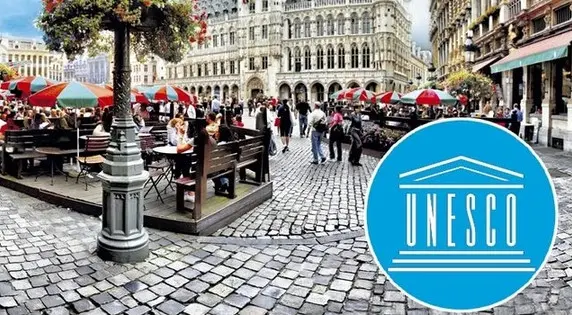
World Heritage in Belgium is a micro-model of excellence. From the Grand-Place in Brussels to the hydraulic boat lifts of the Canal du Centre, the country illustrates European engineering and aesthetics. The inscription of Spa in 2021 (Great Spa Towns of Europe) confirms this dynamic of active preservation.
5. Communication: Freedom of the Press
The UNESCO Observatory reports over 1,800 journalists murdered since 1993. With an impunity rate of 86%, the organization campaigns for the Global Media Defence Fund and the protection of environmental journalists, who are particularly exposed (70% of reported attacks).
Geopolitical Tensions: The American Oscillation
Intellectual multilateralism is structurally exposed to Realpolitik. The withdrawal of the United States, notified in 2026 for an effective exit at the end of 2026, creates a major capability and financial vacuum (the US budget historically representing 22% of contributions). This disengagement, motivated by the "America First" doctrine, opens a window of geostrategic opportunity for China, which is intensifying its power projection within the organization's standard-setting bodies.
Signature of the Constitution in London.
Adoption of the World Heritage Convention.
Inscription of Spa (Belgium) as a World Heritage site.
Election of Khaled El-Enany (Egypt) as head of the organization.
Effective withdrawal of the United States of America.
Conclusion
UNESCO navigates the crossroads of the highest human aspirations and the implacable realities of geopolitics. In the face of biodiversity erosion and technological leaps, it remains the last intellectual bulwark of the world. Its ability to reinvent itself under the leadership of Mr. El-Enany will determine whether it remains the moral conscience of the United Nations for decades to come.