Jean-Luc Demaret G
« A perfect family day on the Semois. The welcome at Kayak Semois Ardenne is warm, the equipment is spotless (the kayaks are modern and clean), and the free shuttle system is superbly organised. A must-visit in the Ardennes! »
Benedictine Heritage, Gastronomic Tradition & Silence of the Molignée
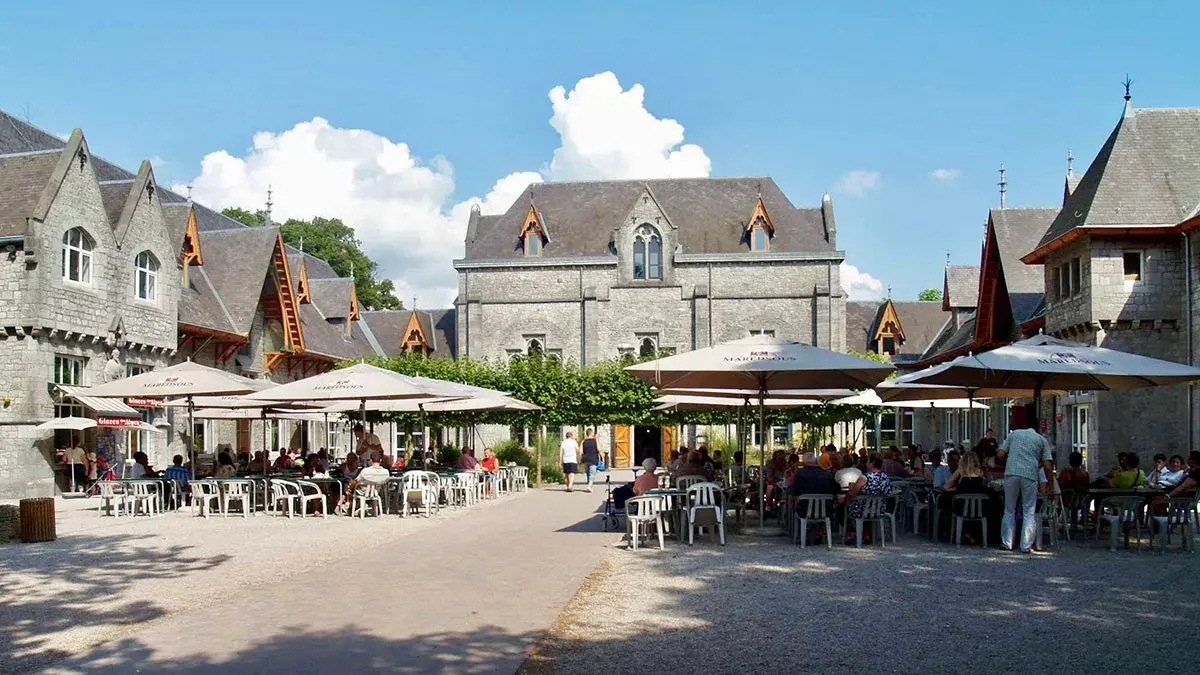
Located in the lush Molignée Valley, in the Namur province, Maredsous Abbey is one of the most iconic monastic sites in Northern Europe. Founded in 1872 by the Desclée family, at the instigation of monks from Beuron Abbey in Germany, it embodies the revival of Benedictine monasticism in the 19th century.
It is not just a place of prayer, but a crossroads where history, neo-Gothic architecture, and gastronomic pleasures meet for more than 400,000 annual visitors. Whether you are looking for spirituality, an art lover, or a gourmet, Maredsous welcomes you with the traditional hospitality of the sons of Saint Benedict.
The name "Maredsous" has complex roots, a mix of Old French and local influences. It likely refers to a "mare" (pool) or a damp area "under" (sous) or near a plateau. Geologically, the abbey is built on a base of carboniferous limestone, typical of the Condroz region. This stone, quarried from local sites in the Molignée valley, gives the building its robustness and timeless appearance.
The valley itself is a magnificent example of an incised meander, carved over millennia by the small Molignée river. This particular topography favored the isolation necessary for monastic life while providing essential natural resources (water, stone, wood). The orientation of the abbey church is designed to capture the light from the southeast, symbolizing the resurrection, while the cloister is protected from the prevailing winds.
The history of Maredsous is inextricably linked to the Desclée family, wealthy industrialists and publishers from Tournai. The brothers Henri and Jules Desclée wanted to found a monastery that would be a center of intellectual and spiritual influence. In 1872, they called upon the monks of Beuron (Germany), who were seeking refuge following Bismarck's "Kulturkampf".
The first stone was laid on September 3, 1872. This construction site was one of the largest in Belgium at that time. Under the leadership of Father Hildebrand de Hemptinne, the community grew rapidly. From 1878, Maredsous became an autonomous abbey within the Beuron congregation, before taking the lead of its own Belgian congregation in 1920. The abbey played a leading role in the modern liturgical movement, notably thanks to figures like Dom Columba Marmion, the third abbot, who was beatified in 2000 due to the worldwide influence of his spiritual writings.
Expert's Note: "Maredsous Abbey is a fascinating example of how a religious institution can become a local economic engine without losing its spiritual integrity. It is a 'place of memory' that communicates with modernity, a true cultural beacon for all of Wallonia."
From the first stone by the Desclée family to the international influence of its learned monks.
The Desclée family finances the construction of the abbey on inherited land. The first monks arrive from Germany.
The monumental abbey church is consecrated and becomes the beating heart of the community.
Start of artisanal production of Maredsous cheese, following a monastic recipe refined in the abbey cellars.
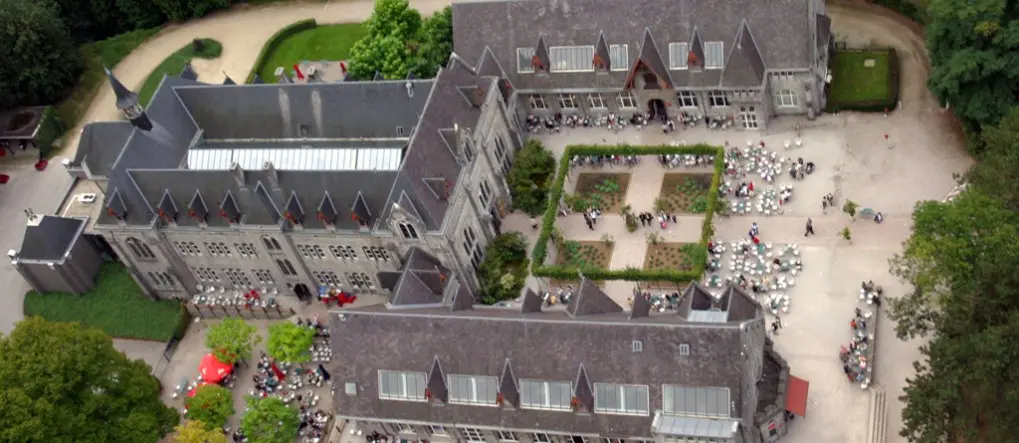
The architecture of Maredsous is the masterpiece of Baron Jean-Baptiste Bethune, the leader of the neo-Gothic movement in Belgium. Unlike abbeys rebuilt on medieval remains, Maredsous was designed ex nihilo, offering a rare stylistic coherence.
The abbey church, with its two massive square towers over 80 meters high, is reminiscent of the great cathedrals on the Rhine. The 78-meter-long nave impresses with its sobriety, inviting reflection. The choice of limestone from the Molignée is not just aesthetic; it anchors the abbey in its terroir.
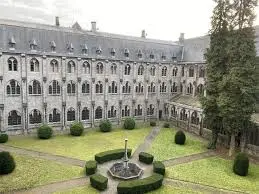
Beyond the walls, Maredsous is a living community of monks who follow the Rule of Saint Benedict, written in the 6th century. This rule rests on two fundamental pillars: Ora et Labora (Pray and Work). The monk's day is rhythmicized by the Opus Dei (the work of God), the sung offices that resound through the abbey church seven times a day.
Hospitality is a central value: "All guests who arrive are received as Christ," states the Rule. This openness is expressed today in the welcome of thousands of visitors, but also in the monastic guesthouse which offers retreats in silence.
Resident Monks
Visitors / Year
Founding Year
Tower Height
Maredsous cheese is more than a product; it is a technical heritage. Aged in the abbey's cellars at a constant humidity of 95% and a temperature of 12°C. Brushing with brine creates the famous natural orange crust.
Maredsous 6 (Blonde), 8 (Bruin) and 10 (Tripel) beers remain under the strict supervision of the monks. Served at 6 to 10°C in their iconic chalice glass, they represent the peak of the Belgian abbey beer tradition.
By Quentin Deligne, Heritage & Tourism Expert
"Maredsous represents what I call entrepreneurial monasticism. It has created a strong brand synonymous with quality. The challenge for 2026 is managing 400,000 visitors while preserving the serenity of the valley."
The abbey is open all year round. The 'Saint-Joseph' welcome center offers a cafeteria, a shop, and a large playground for children.
Address: Rue de Maredsous 11, 5537 Denée.
Tip: Combine your visit with a trip on the Draisines of the Molignée or a hike along the RAVeL 150 route.
Sources: Wikipedia - Maredsous Abbey | Expertise: Quentin Deligne | Update: May 2026
↑ Back to topNoté 4.6/5 sur 1282 avis
« A perfect family day on the Semois. The welcome at Kayak Semois Ardenne is warm, the equipment is spotless (the kayaks are modern and clean), and the free shuttle system is superbly organised. A must-visit in the Ardennes! »
« Beautiful kayak trip on the Semois starting from Vresse! Very friendly staff and excellent shuttle service. The riverside campsites along the Semois are also a must for nature lovers. »
« Superb 11 km kayak descent starting from Alle-sur-Semois. The wild nature of the Ardennes is magnificent in the spring sunshine. Very competitive prices compared to the competition. We'll be back! »
« Wonderful experience! The kayak tour on the Semois was perfectly organised. The team is very helpful and speaks good German. The scenery of the Belgian Ardennes is simply breathtaking. »
« Excellent kayak rental service and great campsite on the banks of the Semois. The prices are very fair and the atmosphere is friendly and family-oriented. The little terrace bar is perfect for a refreshing drink after the effort. »
« A fantastic last-minute welcome even though we hadn't booked in the middle of August. Life jackets and waterproof barrels are provided free of charge. Very safe descents, ideal with children! »
« Top-tier kayak rental on the Semois river. Extremely friendly staff, well-maintained kayaks, and a reliable shuttle. The viewpoints along the river are absolutely stunning. Highly recommend this local business! »