🎧 Listen to this article

Save time by listening to the complete audio version with exclusive commentary on each technique.

Chapters

  • 00:00Introduction
  • 00:45Paddle grip & posture
  • 02:30Forward Stroke
  • 03:30Sweep & Draw Stroke
  • 04:30Low Brace — balance
  • 05:05Conclusion
Show complete transcript

Introduction — Welcome to this audio guide on kayak paddling techniques. Whether you are a beginner or looking to consolidate your basics, this guide will accompany you step by step.

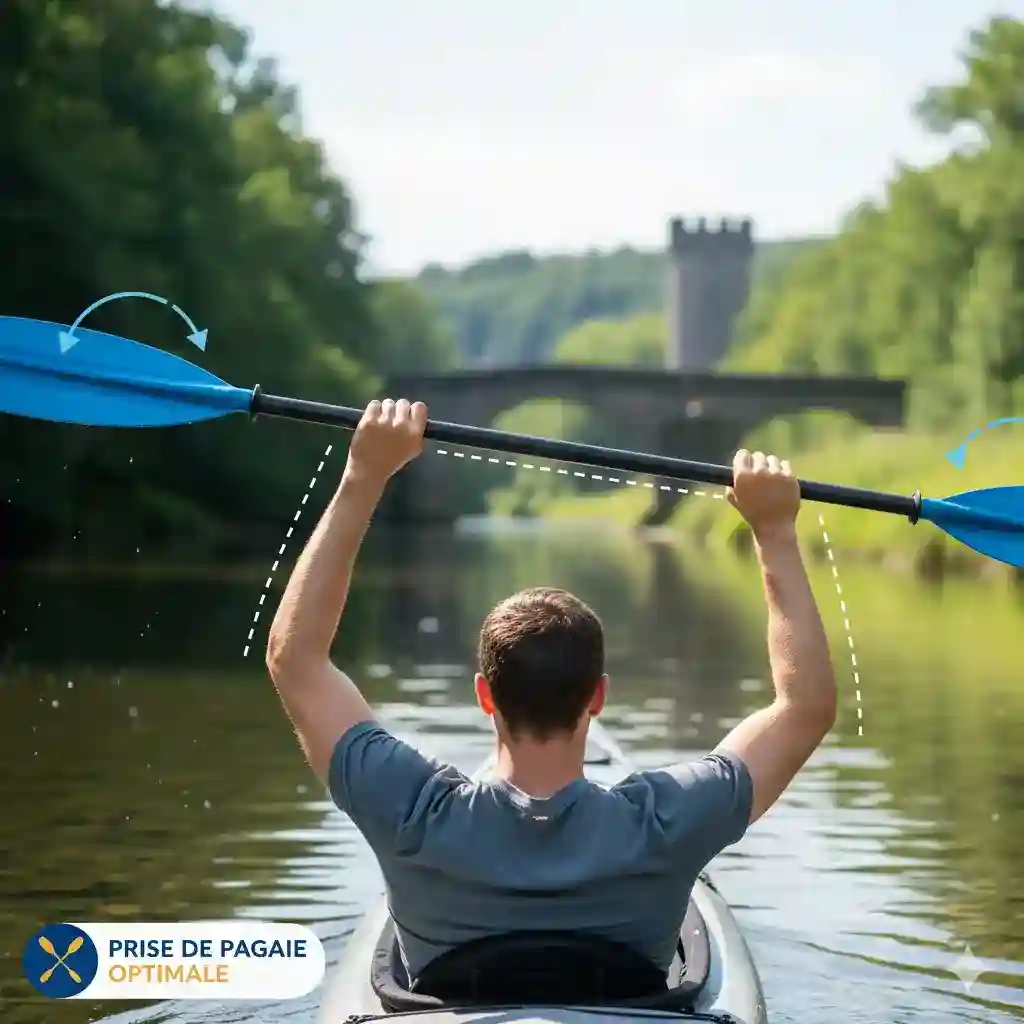
The paddle grip — Raise the paddle above your head with your elbows at 90° to find the ideal hand spacing. The hollow face of the blade, the power face, should be facing you. Form an O with your thumb and index finger, and keep your wrists straight to prevent tendinitis.

The 3-point posture — Straight back, knees in contact with the sides of the cockpit, feet on the footrests. This triangle of contact allows you to transmit your body's power to the kayak through your hips.

The Forward Stroke — Power comes from torso rotation, not the arms. Catch phase: plant the blade far forward. Power phase: rotate your torso. Exit phase: remove the blade at hip level.

Sweep Stroke and Draw Stroke — To turn, trace a wide arc (sweep stroke) on the side opposite to your direction. To move laterally, plant the blade vertically and pull it towards your hip (draw stroke).

The Low Brace — Anti-capsize reflex: slap the surface of the water with the back of the blade, elbows high, and simultaneously give a strong hip snap on the opposite side. Never let go of your paddle.

Conclusion — These fundamentals can be learned in 30 to 60 minutes on calm water. Practice each movement separately before linking them naturally.
1. Equipment and Posture

Before even paddling, proper setup is the key to power, control, and comfort.

The Paddle Grip

A correct grip ensures efficient power transfer and prevents fatigue.

Hand Spacing

Lift the paddle above your head with elbows at 90°: this spacing is your ideal reference.

Blade Orientation

The hollow face (power face) must face you. For asymmetrical blades, the longer part goes on top.

Relaxed Grip

Form an "O" with your thumb and index finger, let the other fingers rest on the shaft. Keep wrists straight to avoid tendinitis.

Good kayak posture: 3-point contact seat–knees–footrests

Posture: 3-Point Contact

Straight back, knees pressed against the sides of the cockpit, feet on the footrests. This contact triangle allows you to steer the kayak with your hips and prevents numbness.

Seat Knees Footrests

2. Essential Maneuvers

Propulsion, braking, turning, and lateral movement — select a maneuver to see the detailed explanation.

3. Balance and Safety

Good balance is dynamic, not static. Stay relaxed and learn how to react with your paddle.

The Low Brace

This is your number one safety reflex. If you feel the kayak tipping, do not tense up — lean into the fall and use your paddle.

  • 1
    Action: Quickly slap the surface of the water with the back of your blade. Elbows high, shaft low against your torso.
  • 2
    Reaction: Simultaneously, give a strong hip snap on the opposite side to right the boat.
  • 3
    Most importantly: Never let go of your paddle — it is your permanent outrigger.

Hover = demonstration

Tipping kayak
Stabilized!

Frequently Asked Questions

Is it difficult to learn how to kayak?

The basics — propulsion, braking, and elementary turning — can be acquired in 30 minutes to 1 hour on calm water. Progressing to advanced techniques like the Eskimo roll or whitewater navigation requires more practice with a certified instructor.

What is the difference between a kayak and a canoe?

Kayaking is done sitting down with your legs extended in a closed cockpit using a double-bladed paddle (one blade on each side). Canoeing is done kneeling or on a bench in an open boat using a single-bladed paddle.

How do you avoid capsizing in a kayak?

Three rules: (1) adopt the 3-point posture (seat, knees, footrests); (2) stay relaxed — a rigid body amplifies imbalance; (3) master the low brace which rights the kayak in a fraction of a second.

How do you paddle in a straight line in a kayak?

Alternate symmetrical strokes on each side, exit the blade before it passes your hip, and use slight sweep stroke corrections rather than changing your trajectory with every stroke. A long kayak is inherently more stable in a straight line.

What is the Eskimo roll in kayaking?

The Eskimo roll allows you to right yourself after capsizing without leaving the cockpit: a coordinated movement of the hips and paddle brace brings the kayaker back upright. It must imperatively be learned in a pool with a certified instructor.

How do you hold a kayak paddle correctly?

Spread your hands shoulder-width apart + 10 cm (elbows at 90° above the head to check). Form an O with your thumb and index finger, straight wrists — a tense grip fatigues the forearms and causes tendinitis.
4.6/5
Based on 1,356 customer reviews
🏆
Excellence
2024
Verified Reviews
100%
N
Nathalie Frédéric

Very good, cheap and very friendly welcome. Thank you, because for my first time kayaking, I love it. I recommend it. See you next time 👍🙂

M
Marlène Régibo

Contrary to other published opinions, we were very well received, the team is very friendly and the kayak rental is cheaper here than elsewhere. We recommend Kayak Ardenne!

K
Konrad

Fantastic campsite, affordable prices and adorable staff!

L
Lauranne Arimont

Top, very friendly and good service. Correct prices.

L
Loan

We stayed 1 night in a tent and did the 11km kayak descent. Helpful and super friendly staff. Perfect organization for arrival on the Semois and reception after the descent. Thanks for everything!

K
Kelly Watillon

We were able to enjoy this day thanks to the lady at the kayak bar! Without knowing it, we hadn't booked. She found a last minute solution! Top thanks again! Thanks to her and also to the drivers who brought us back.

A
Arthur Pinter

Excellent kayak rental on the Semois. Different routes possible for short or long distance depending on the wish. The staff is very friendly and advises you perfectly!

L
Laurie Rainbow

Magnificent canoe descent (17km), the service is very good, we wait little even at arrival thanks to the driver and his wife who willingly answer our questions and calls. In addition, the small cafe with terrace is very pleasant. The night at the campsite was perfect.