Jean-Luc Demaret G
« A perfect family day on the Semois. The welcome at Kayak Semois Ardenne is warm, the equipment is spotless (the kayaks are modern and clean), and the free shuttle system is superbly organised. A must-visit in the Ardennes! »
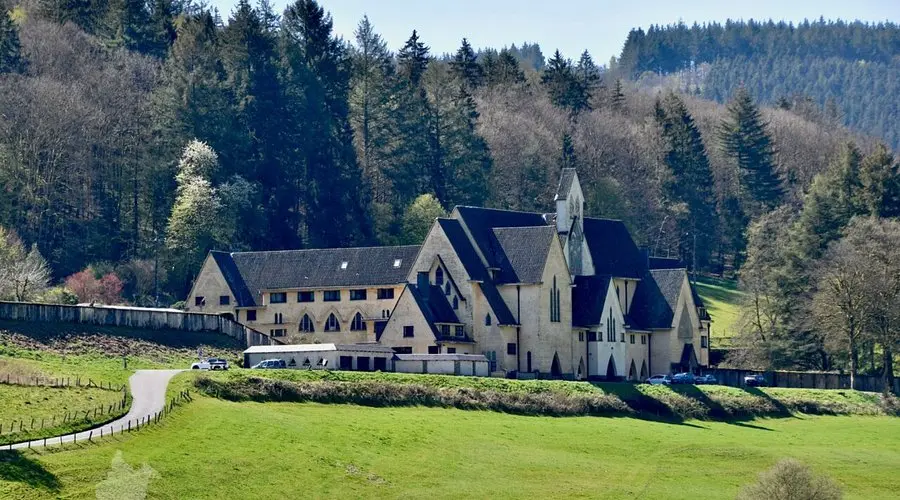
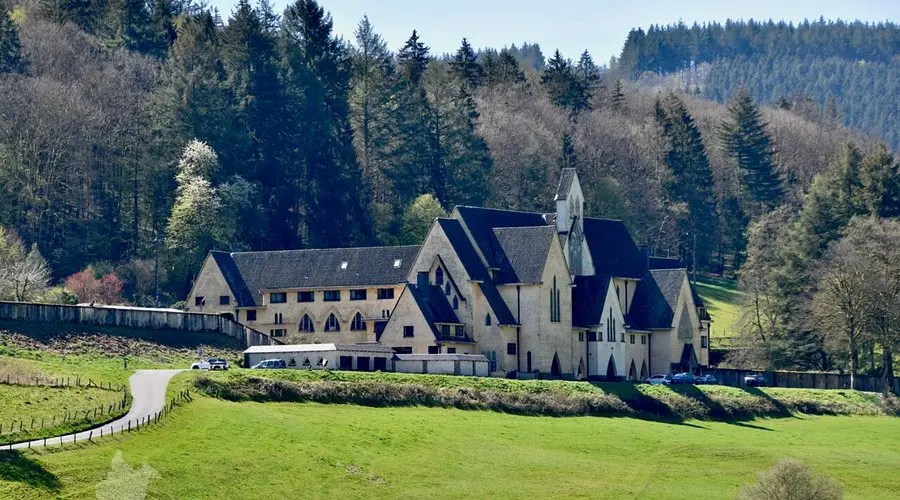
In a meander of the Semois, a stone's throw from the Bouillon Castle, the Cordemois Abbey crystallizes eight centuries of spiritual continuity — from the comital necropolis of Ermesinde of Luxembourg (1247) to the concrete arches of Henri Vaes symbolizing joined hands, up to the unprecedented canonical agreement of July 2024.
Comital necropolis · Cistercian resilience · Meander of the Semois
The Notre-Dame de Cordemois Abbey is the direct heir to the Clairefontaine abbey, founded in 1247 by Countess Ermesinde of Luxembourg. For a century, this site served as a necropolis for the comital family of Luxembourg — guaranteeing Cistercian spiritual protection for the dynasty. Suppressed by the French Revolution (1794-1796), the tradition survived in France before resettling in this Ardennes meander in 1933-1934.
The resurrection of Cordemois is part of the great movement of Belgian monastic renewal led by Dom Marie-Albert van der Cruyssen — the same restorer who breathed life into the Orval abbey. The nuns, coming from La Cour Pétral (Diocese of Chartres), chose this site for its geographic solitude, fulfilling the Cistercian ideal of withdrawal from the world in a preserved natural setting.
"The Cordemois Abbey represents much more than an architectural or tourist curiosity. It is the fruit of a tenacious will to maintain a spiritual presence in a changing world."
Photographic documentation
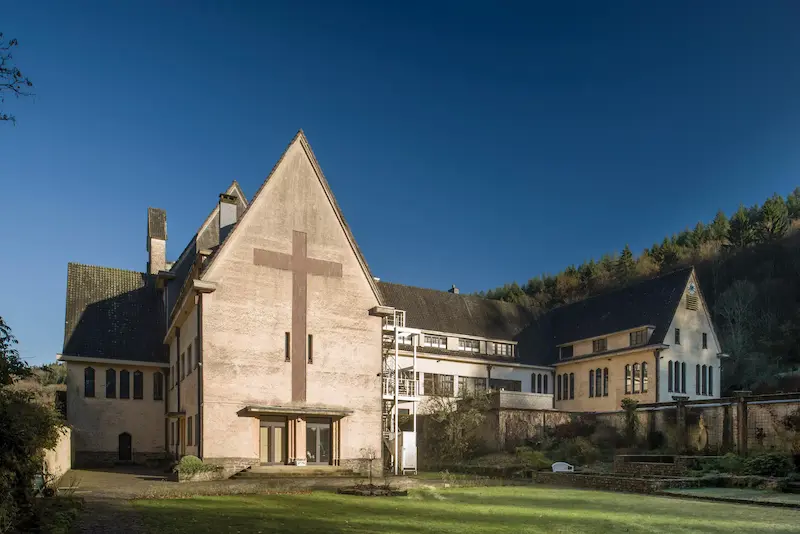
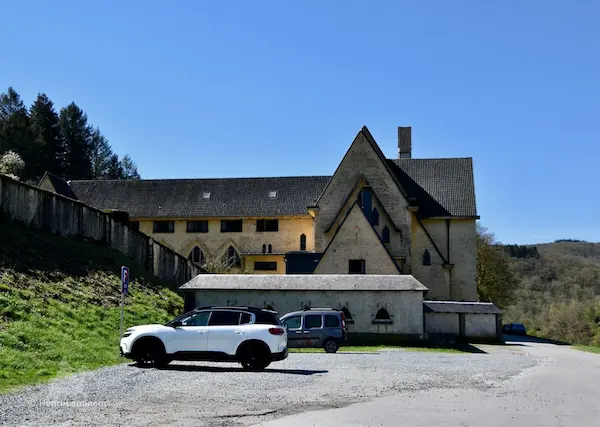
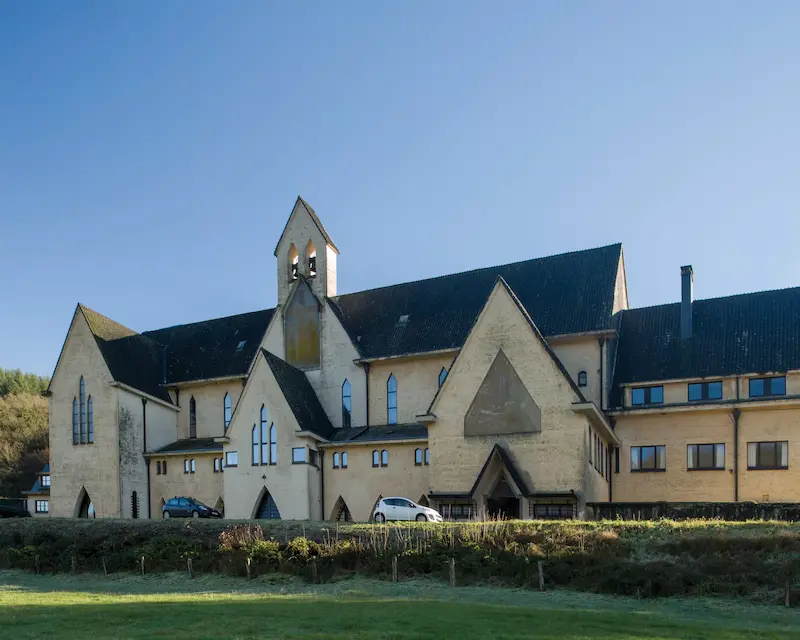
📜 From Clairefontaine to Cordemois · 1247–2024
Understanding the Cordemois abbey requires going back to the 13th century, in Luxembourg territory. This is where the spiritual tradition that still irrigates this Ardennes meander today takes root.
1247–1253
The abbey — initially named Beaulieu then Clairefontaine in 1253 — was founded near Arlon, attached to the Cistercian order under the jurisdiction of Clairvaux. Its role was crucial: to serve as a necropolis for the comital family of Luxembourg. For a century, Ermesinde's descendants were buried there, ensuring the symbiosis between temporal power and spiritual protection.
Cistercian comital necropolis15th–17th century
Periods of disciplinary decline in the 15th century, ravages of the Thirty Years' War. But every destruction was followed by a reconstruction and renewed fervor, especially in the 18th century, testifying to Cistercian resilience in the face of historical trials.
Cycles of decline and renewal1794–1796
French revolutionary troops burned and suppressed the abbey. Monastic life in Arlon came to an abrupt end. The spiritual lineage did not disappear: nuns preserved the tradition in France.
End of monastic life in Arlon1845
The continuity of the lineage was ensured by a foundation in the Diocese of Chartres. The female Cistercian tradition of Clairefontaine was preserved outside Belgium for nearly a century, awaiting the conditions for a return to Ardennes soil.
Preservation of the spiritual lineage1933–1934
The return to Belgium was part of the great movement of monastic renewal led by Dom Marie-Albert van der Cruyssen, the restorer of the Orval abbey. The nuns from La Cour Pétral chose Cordemois for its geographic solitude in the meander of the Semois. The title of Clairefontaine was revived.
Renewal – Dom van der Cruyssen1930–1935
The Antwerp architect Henri Vaes (1876-1945) created the plans between 1930 and 1935. The reinforced concrete was hoisted over the Semois. The hillside location dictated a vertical organization around a square cloister. At the same time, the schist Poulie Bridge was built.
Concrete + Ardennes schist architecture2016
The Cistercian Order of the Strict Observance (OCSO) announced the official closure of the abbey, citing insurmountable internal tensions. This began a period of 8 years of uncertainty, legal procedures, and resistance from 6 sisters refusing to leave the premises.
8 years of proceedingsJuly 2024
An amicable agreement was reached with the Holy See. The remaining 6 sisters can continue their monastic life. The institution takes the name of Cordemois Abbey, leaves the OCSO, and comes under the jurisdiction of the Diocese of Namur. A new chapter begins.
Canonical autonomy – Diocese of Namur| Period | Event | Impact |
|---|---|---|
| 1247-1253 | Ermesinde Foundation | Luxembourg comital necropolis |
| 1253 | Renamed Clairefontaine | Attachment to Cîteaux/Clairvaux |
| 1794-1796 | Revolutionary fire | End of monastic life in Arlon |
| 1845 | La Cour Pétral (France) | Preservation of the lineage |
| 1933-1934 | Settlement in Cordemois | Revival of Clairefontaine title |
| 1930-1935 | Henri Vaes plans | Reinforced concrete + Ardennes schist |
| 1933 | Géo De Vlamynck Stained Glass | Campanile frescoes + stained glass |
| 2016 | Announced OCSO closure | 8 years of resistance by the sisters |
| 2024 | Canonical agreement | Cordemois Abbey – Diocese of Namur |
Sources: Wikipedia · CathoBel · guides.archi · arlon-clairefontaine.com
🏗️ Henri Vaes (1876-1945) · Cistercian modernity laboratory
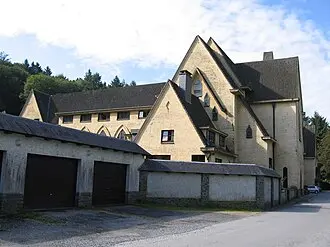
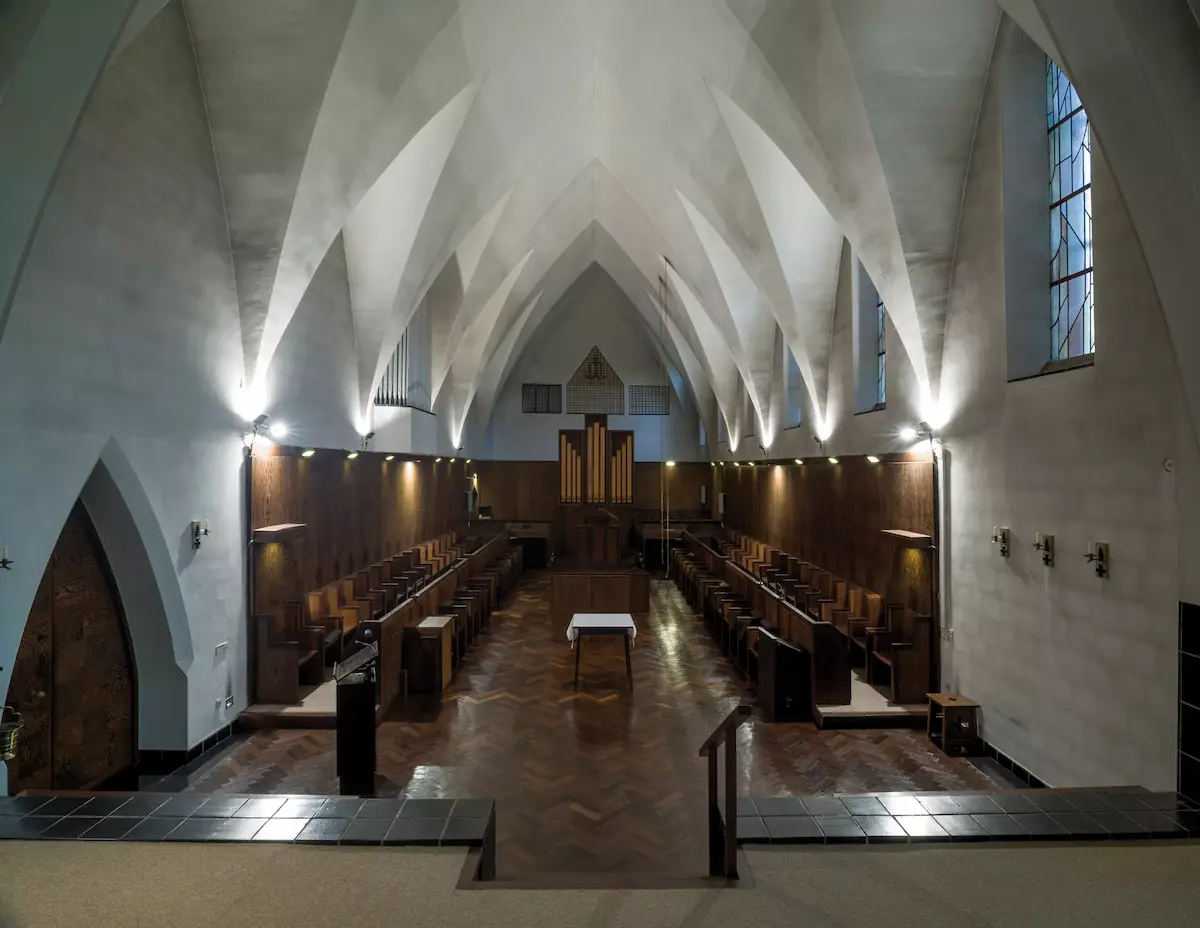
Cordemois was for Henri Vaes the precursor and test model for Orval — his most famous project. The Antwerp architect deployed a vision where reinforced concrete, a modern material, serves an aesthetic inspired by the Middle Ages without ever falling into pastiche. The concrete was literally hoisted over the Semois to reach the hillside.
| Element | Material | Aesthetic effect |
|---|---|---|
| Structure | Reinforced concrete (winched over the Semois) | Technical modernity and solidity |
| Outer facing | Light plaster and regional schist | Landscape integration and sobriety |
| Woodwork | Wenge wood | Warmth and contrast with white |
| Interior details | Black ceramics and dark stones | Marking corners and openings |
| Neo-Gothic arches | Shaped concrete | Symbolism: hands joined for prayer |
The abbey is not just a concrete structure. It is inhabited by the interventions of major interwar artists. A true iconographic journey leads the visitor from the outer cloister to the heart of the church.
🎨 Stained glass – Abbey church
Yoors, Colpaert, Jacques de Géradon and Géo De Vlamynck. Play with light to define sacred spaces.
🖼️ Frescoes & stained glass – Campanile
Géo De Vlamynck (1933): mural fresco + campanile stained glass. First decisive intervention in the "modern" aesthetics of the complex.
🌿 Frescoes – Outer cloister
Jan Huet, Marcel Laforêt, Irène Vander Linden and Guillemine Capart-Vaes. Iconographic journey preparing the entry into the sanctuary.
⛪ Spatial organization
Square cloister in the center · Ground floor partially buried (slope) · First floor: vital functions of the monastery
⚖️ 2016–2024 · 8 years of resistance · July 2024 Agreement
In 2016, the OCSO announced the closure of the abbey. Six sisters refused to leave. After 8 years of legal proceedings, an unprecedented agreement was reached in July 2024 — creating a new canonical entity unique in Belgium.
After eight years of uncertainty and procedures, this amicable agreement resolves the difficulties arising from the closure announced in 2016. It allows the six remaining sisters to continue their life of prayer and work within the walls they refused to leave.
The canonical entity "Notre-Dame de Clairefontaine Abbey" is definitively abolished. The institution officially becomes the "Cordemois Abbey", managed by a new eponymous NPO.
The nuns officially leave the fold of the Cistercian Order of the Strict Observance. They retain their religious status, thus escaping the reduction to the lay state that threatened them for disobedience. Financial assets are shared equitably with the monasteries that welcomed the sisters who left after 2017.
The community is now under the direct responsibility of the Bishopric of Namur. A new definitive status will be established by Bishop Pierre Warin's successor, anchoring the nuns in an unprecedented local autonomy.
Despite the changes in guardianship, daily life in Cordemois remains governed by the Rule of Saint Benedict. The balance between community prayer, silence, and manual work is maintained. The sung liturgy remains open to the public.
"Humility, truth, and simplicity remain values capable of crossing centuries and institutional crises."
Audio story · 5 min · French 🇫🇷
Les Sœurs rebelles de Cordemois
🕰️ Rule of Saint Benedict · Community prayer · Spiritual retreats
| Service / Activity | Time | Characteristics |
|---|---|---|
| Vigils | 05:00 | Sundays and solemnities |
| Lauds | 07:00 | Morning prayer 🌍 Public welcome |
| Eucharist | 08:45 / 11:00 | Weekdays 8:45 AM · Sunday 10:30 or 11:00 AM 🌍 Public welcome |
| None | 14:45 | Afternoon prayer |
| Vespers | 18:00 | 🎵 Evening service – often sung · Recommended 🌍 Public welcome |
| Compline | 20:00 | Prayer before the great silence of the night |
Indicative hours – check the abbey's website before your visit
The abbey offers spiritual retreats for individuals or groups. Guests share the silent climate of the monastery for stays of rejuvenation. Meals are taken in silence, encouraging introspection and listening to the Word of God. Cycles of recollection, concerts, and sacred art workshops are scheduled for 2026-2027.
In accordance with the Cistercian tradition, the nuns support themselves through the fruit of their labor. The artisanal bakery is the most iconic activity.
Cramique
Brioche bread with raisins. Absolute star — sells out upon opening Friday. Arrive early!
Artisanal bakeryCraquelin
Brioche bread with sugar. Complementary variant to the cramique. Limited production.
Artisanal bakeryButter biscuits
Varied range of dry and shortbread biscuits following traditional recipes passed down by the community.
Biscuit factoryArtisanal cakes
Apple, almond, or fruit cakes depending on the season and availability.
PastryCeramics
Ceramic objects made by the community. Unique artisanal pieces.
Monastic artSilk paintings
Artistic creations by the sisters. Also: Trappist beers, cheeses, religious bookstore from other European abbeys.
Monastic art💡 Tip: arrive early on Friday for cramiques and craquelins — they go fast.
🌉 Poulie Bridge · Épine Footbridge · Meander of the Semois
The abbey is inseparable from its landscape. Nestled in an "ocean of greenery", it establishes a constant dialogue between concrete and stone architecture and the flowing water of the Semois.
Built in 1935 simultaneously with the monastery by Henri Vaes in local schist, this bridge with elegant arches has become a must-see photographic spot. Its location offers a clear view of the Bouillon Castle. It constitutes the symbolic entry point to the abbey from the town. For kayakers navigating the Semois from Poupehan, it is one of the first architectural landmarks visible from the river.
Suspended structure of 55 meters long in Douglas fir wood and metal connecting the two banks of the Semois near Cordemois. It allows access to steep paths leading to the famous panoramas of the Ardennes ridges. The Épine Footbridge is a highlight of the Cordemois and Belvédère Circuit (7 km) and the Hanged Man's Rock hike (~15 km).
The abbey is nestled in a meander of the Semois between Poupehan and Alle-sur-Semois. During the Poupehan → Alle (10 km, 2h-3h) kayak trip, it appears at the exit of a meander — the white light plaster facade contrasts with the dark Ardennes forest. The bells toll the hours — from the river, it is an exceptionally sweet sound in the silence of the valley.
🛶 Book the Poupehan → Alle route →🏗️ Henri Vaes (1876-1945) · Laboratory of Cistercian Modernity
Cordemois was for Henri Vaes the precursor and test model for Orval — his most famous commission. The Antwerp architect developed a vision where reinforced concrete, a modern material, serves an aesthetic inspired by the Middle Ages without ever falling into pastiche. The concrete was literally hoisted over the Semois to reach the hillside.
| Element | Material | Aesthetic Effect |
|---|---|---|
| Structure | Reinforced concrete (hoisted over the Semois) | Technical modernity and solidity |
| Exterior facing | Light coating and regional slate | Landscape integration and sobriety |
| Woodwork | Wenge wood | Warmth and contrast with white |
| Interior details | Black ceramics and dark stones | Marking of angles and openings |
| Neo-Gothic ogives | Shaped concrete | Symbolism: hands joined for prayer |
The abbey is not just a concrete structure. It is inhabited by the interventions of major interwar artists. A true iconographic route leads the visitor from the outer cloister to the heart of the church.
🎨 Stained Glass – Abbey Church
Yoors, Colpaert, Jacques de Géradon and Géo De Vlamynck. Play with light to define sacred spaces.
🖼️ Frescoes & Stained Glass – Campanile
Géo De Vlamynck (1933): mural fresco + bell tower stained glass. First decisive intervention in the "modern" aesthetic of the complex.
🌿 Frescoes – Outer Cloister
Jan Huet, Marcel Laforêt, Irène Vander Linden and Guillemine Capart-Vaes. Iconographic route preparing the entrance to the sanctuary.
⛪ Spatial organization
Square cloister in the center · Ground floor partially underground (slope) · First floor: vital functions of the monastery
⚖️ 2016–2024 · 8 Years of Resistance · July 2024 Accord
In 2016, the OCSO announced the closure of the abbey. Six sisters refused to leave. After 8 years of legal proceedings, an unprecedented agreement was concluded in July 2024 — creating a new canonical entity unique in Belgium.
After eight years of uncertainty and procedures, this amicable agreement resolves the difficulties arising from the closure announced in 2016. It allows the six remaining sisters to pursue their life of prayer and work within the walls they refused to leave.
The canonical entity "Notre-Dame de Clairefontaine Abbey" is definitively suppressed. The institution officially becomes "Cordemois Abbey", managed by a new eponymous non-profit organization (ASBL).
The nuns officially leave the Cistercian Order of the Strict Observance. They retain their religious status, thus escaping the reduction to the lay state that threatened them for disobedience. Financial assets are shared equitably with the monasteries that welcomed the sisters who left after 2017.
The community is now under the direct responsibility of the Bishopric of Namur. A new definitive status will be established by the successor of Bishop Pierre Warin, anchoring the nuns in an unprecedented local autonomy.
Despite the changes in oversight, daily life at Cordemois remains governed by the Rule of Saint Benedict. The balance between community prayer, silence, and manual work is maintained. The chanted liturgy remains open to the public.
"Humility, truth, and simplicity remain values capable of crossing centuries and institutional crises."
Audio Story · 5 min · French 🇫🇷
The Rebel Sisters of Cordemois
🥾 3 hiking trails · Bouillon · Cordemois · Belvédère
The abbey is the anchor point for several hiking routes crossing century-old Douglas fir forests and offering panoramas over the meanders of the Semois. It can be the destination or the starting point.
Red rectangle · ~2h30 · Easy
Departure from the Porte de France in Bouillon. Follows the Semois to reach the abbey. Crosses the Poulie Bridge (schist, 1935) with a view of the castle. Ideal for a first cultural approach to Cordemois from the river path.
~2h30 · Intermediate · Climb
Loop crossing century-old Douglas fir forests. Climb to the belvedere for a breathtaking view of the town of Bouillon and the meanders of the Semois. Passes by the Épine Footbridge (55m) in Douglas fir wood and metal.
Sporty · Full day
Long hike connecting Corbion and Bouillon. Passes by the Cordemois Bridge and the Épine Footbridge. Panoramas over the Ardennes meanders from the Hanged Man's Rock. Reserved for experienced hikers with good physical condition.
Reach Cordemois from Bouillon
From Bouillon (~1.5 km), cross the Poulie Bridge (schist arches, 1935). This is your first photo stop with a clear view of the Castle. By car, parking is possible before the abbey. On foot from the Porte de France: start of the BN hike n°41 (red rectangle).
Observe the outer cloister and the church
Free access to the exteriors. Observe the frescoes of the outer cloister (Jan Huet, Marcel Laforêt, Irène Vander Linden, Guillemine Capart-Vaes). In the church: stained glass by Géo De Vlamynck (1933) and works by Yoors, Colpaert, Jacques de Géradon. Vaes's neo-Gothic concrete arches symbolize hands joined in prayer.
Attend a liturgical service
The Vespers (6 PM) are particularly recommended — sung, open to the public. The Sunday Eucharist (10:30-11 AM) is the most accessible service. Respect the silence and appropriate dress required on the premises.
Visit the monastic shop
Arrive early on Friday for cramiques and craquelins — they sell quickly. Mar-Oct: Tue-Sun 2 PM-5:30 PM. Nov-Feb: Wed-Sun 2 PM-4:30 PM. Don't miss the artisanal ceramics and silk paintings.
Follow up with a hike
The Cordemois and Belvédère Circuit (7km, ~2h30) is the best extension: century-old Douglas fir forests, Épine Footbridge (55m), panoramic view of Bouillon from the belvedere.
Frequently asked questions
The Cordemois Abbey is the spiritual successor to the Clairefontaine abbey, founded in 1247 by Countess Ermesinde of Luxembourg near Arlon. This abbey served as a necropolis for the comital family of Luxembourg. After the French revolutionary fire of 1794-1796, the tradition survived in France before the nuns settled in Cordemois in 1933-1934, spurred by Dom Marie-Albert van der Cruyssen, the restorer of the Orval abbey.
Henri Vaes (1876-1945) is an Antwerp architect who designed the abbey between 1930 and 1935 — Cordemois being his precursor and test model before the major Orval project. He used reinforced concrete (hoisted over the Semois), regional schist, wenge wood, and black ceramics. The neo-Gothic arches symbolize hands joined for prayer, thus transforming the load-bearing structure into a permanent liturgical gesture.
Church stained glass: Yoors, Colpaert, Jacques de Géradon and Géo De Vlamynck. The latter also created a mural fresco and stained glass for the campanile in 1933. Frescoes in the outer cloister: Jan Huet, Marcel Laforêt, Irène Vander Linden and Guillemine Capart-Vaes.
After 8 years of resistance since the closure announcement by the OCSO (2016), an agreement was concluded in July 2024. Three points: (1) The "Notre-Dame de Clairefontaine Abbey" becomes the Cordemois Abbey (NPO) ; (2) The 6 sisters leave the OCSO but keep their religious status; (3) The community comes under the jurisdiction of the Diocese of Namur.
Cramiques (raisin brioche bread) and craquelins (sugar) — arrive early on Friday. Butter biscuits, shortbreads, apple/almond/fruit cakes. Artisanal ceramics and silk paintings. Trappist beers, cheeses, and religious bookstore from other abbeys. Shop open Mar-Oct: Tue-Sun 2 PM-5:30 PM · Nov-Feb: Wed-Sun 2 PM-4:30 PM.
The main services accessible to the public: Vespers at 6 PM (often sung — not to be missed), Eucharist on weekdays (8:45 AM) and Sunday (10:30-11 AM), Lauds (7 AM), None (2:45 PM), Compline (8 PM). Vigils (5 AM) are celebrated on Sundays and solemnities.
The Poulie Bridge (also Cordemoys Bridge) was built in schist in 1935 by Henri Vaes. Clear view of the Bouillon Castle — a must-see photographic spot. The Épine Footbridge is a 55-meter suspended structure made of Douglas fir wood and metal, connecting the two banks of the Semois to access the paths of the Ardennes ridges.
Yes. Nestled in the meander of the Semois between Poupehan and Alle, it is visible during the Poupehan → Alle kayak route (10 km, 2h-3h). The white facade contrasts with the Ardennes forest. The bells toll the hours — from the river, this sound is of a rare sweetness in the silence of the valley.
⛩️
The Poupehan → Alle (10 km, 2h-3h) kayak route passes right by the abbey in the meander of the Semois. The bells, the white reflection in the water, the Ardennes forest — a unique sensory experience. Nautical base in Vresse-sur-Semois, from €18 all-in.
Rated 4.6/5 based on 1,282 reviews
« A perfect family day on the Semois. The welcome at Kayak Semois Ardenne is warm, the equipment is spotless (the kayaks are modern and clean), and the free shuttle system is superbly organised. A must-visit in the Ardennes! »
« Beautiful kayak trip on the Semois starting from Vresse! Very friendly staff and excellent shuttle service. The riverside campsites along the Semois are also a must for nature lovers. »
« Superb 11 km kayak descent starting from Alle-sur-Semois. The wild nature of the Ardennes is magnificent in the spring sunshine. Very competitive prices compared to the competition. We'll be back! »
« Wonderful experience! The kayak tour on the Semois was perfectly organised. The team is very helpful and speaks good German. The scenery of the Belgian Ardennes is simply breathtaking. »
« Excellent kayak rental service and great campsite on the banks of the Semois. The prices are very fair and the atmosphere is friendly and family-oriented. The little terrace bar is perfect for a refreshing drink after the effort. »
« A fantastic last-minute welcome even though we hadn't booked in the middle of August. Life jackets and waterproof barrels are provided free of charge. Very safe descents, ideal with children! »
« Top-tier kayak rental on the Semois river. Extremely friendly staff, well-maintained kayaks, and a reliable shuttle. The viewpoints along the river are absolutely stunning. Highly recommend this local business! »