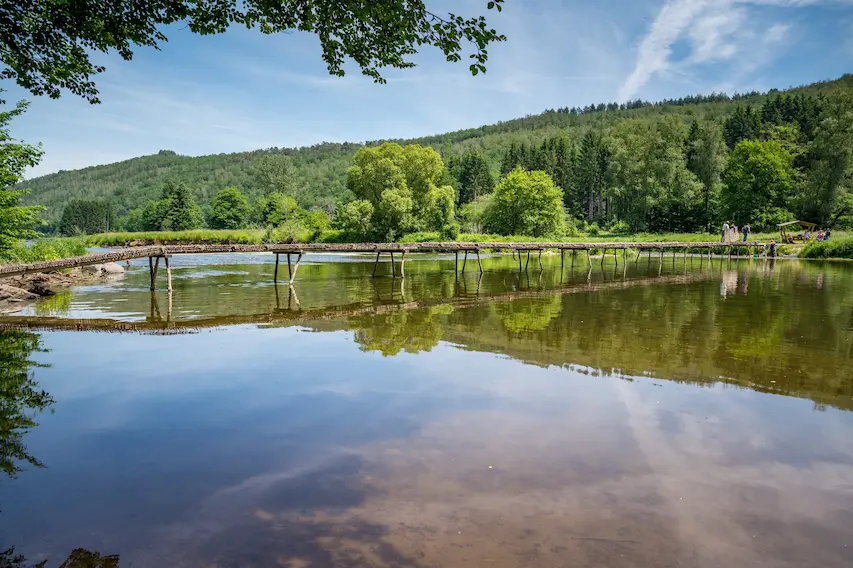
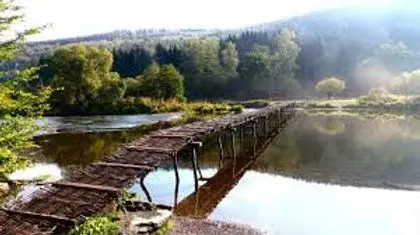
The last woven bridge of the Semois valley — a seasonal masterpiece
of hazel weaving, a living witness to the Ardennes tobacco era,
and an icon of the village of Laforêt.
🌊 Open June–September🪵 ~80 m · 85 woven panels🆓 Free & open access📸 Most photographed site in the Ardennes🥾 3.3 km loop · 1h📍 Laforêt · Vresse-sur-Semois · BE
📏 Length: ~80 meters↔️ Width: 1.40 meters🪵 Panels: ~85 woven sections🗺️ Circuit: 3.3 km loop (1h)🔑 Access:Free🏅 Status: Last woven bridge of the Semois
🌉 A Bridge Like No Other
The Pont de Claies of Laforêt is much more than a pedestrian footbridge.
It is the last representative of a millennial crossing technique
once omnipresent in the Semois valley — a living demonstration
of vernacular Ardennes ingenuity in the face of an unpredictable river's whims.
Each summer, the municipal workers of Vresse-sur-Semois perpetuate an ancestral gesture:
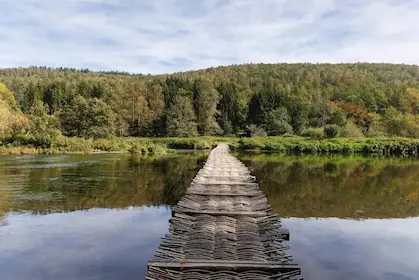
they weave hundreds of hazel branches around a
hornbeam frame to create the claies — these rigid panels that will form the deck
of the bridge. The technique, inspired by Celtic methods of crossing marshy areas,
uses no nails or screws in its original version.
The structure spans the Semois in two sections: the main part crossing the main
branch (~70 meters) and a second of about ten meters reaching
the island towards Chairière. In total: 80 meters long, 1.40 meters wide,
85 assembled woven panels.
Its ephemeral nature is not a weakness: it is a millennial intelligence.
Assembled in June, dismantled in September, the bridge negotiates with the river rather than resisting it.
An early environmental resilience that the Semois National Park has classified
as heritage to be protected.
80m
Total length
85
Woven panels
1.5d
Current assembly time
3.3km
Marked circuit
2022
National Park
1856
Tobacco boom
🏅 Recognition:
Listed among the Most Beautiful Villages of Wallonia ·
Integrated into the Semois Valley National Park (2022) ·
Natura 2000 Site
🌊 Geography & Hydrology of the Semois
The genesis of the woven bridge is intrinsically linked to the unique hydrographic
configuration of the Semois — a river that travels 210 km to connect two
points only 80 km apart as the crow flies.
The Laforêt area is characterized by a fluvial dynamic where the deposit of alluvium
has created soils of exceptional fertility, locally called
"Le Rivage" (The Shore). These lands contrast radically with the poverty of the
schist soils of the surrounding plateaus — an agricultural treasure demanding to be crossed
regularly by farmers.
The Semois has a strong seasonality: marked low water in summer
(allowing the installation of the bridge) and violent winter floods, laden with debris,
capable of destroying any un-masoned structure. The woven bridge is the perfect
answer to this paradox: a temporal infrastructure that retreats before
the river's winter wrath.
The riverbed at the bridge site is rocky and shallowly alluvial,
offering a solid support for the oak trestles driven in manually.
A risk of bottom-freezing in winter reinforces the need for seasonal dismantling.
Parameter
Value / Impact
Total length
210 km (meanders)
Distance as the crow flies
80 km (Arlon → Monthermé)
Bed at bridge site
Rocky & shallowly alluvial
Summer regime
Low water → installation possible
Winter regime
Violent floods → dismantling mandatory
Thermal phenomenon
Risk of bottom-freezing
"Le Rivage" terrain
Fertile alluvial soils (tobacco)
🌿 Semois Tobacco: Catalyst of the Bridge
The existence of the woven bridge is inseparable from a major agricultural revolution:
the industrialization of tobacco cultivation. Without tobacco, there would be no woven bridge.
16th – 18th century
Subsistence farming
Tobacco cultivated for personal and medicinal purposes. The Nicotiana tabacum plant finds an ideal terroir in the Basse-Semois: finely disintegrated acidic schist soils and constant valley humidity.
1856
Joseph Pierret's experiment
Joseph Pierret, a schoolteacher from Alle-sur-Semois, initiates the first large-scale commercial production. Beginning of an economic prosperity that will transform the entire valley.
1885 – 1910
Massive expansion phase
400 hectares planted, 10 million plants. Systematic construction of tobacco drying sheds in all villages. The woven bridge becomes a vital logistical link between the fields of the Rivage and the village drying sheds.
Early 20th century
Golden age of Semois tobacco
Peak of production. Transport by ox and horse teams requires a stable surface: the weaving of the panels makes it the perfect tool for voluminous and fragile harvests.
After 1950
Gradual decline
Mildew, increased taxation, international competition. Gradual abandonment of the Rivage lands. The bridge loses its agricultural function but acquires growing symbolic and heritage value.
🏭 The Laforêt Tobacco Drying Sheds
The prosperity generated by tobacco profoundly altered the architecture of Laforêt.
Tobacco drying sheds — elongated sheds with slatted wooden walls
allowing air circulation — were erected throughout the village.
Some are still visible today on rue Sainte-Agathe. They are part
of the small Walloon heritage protected by the National Park.
🔗 The bridge as an industrial link
Without the woven bridge, transport costs and the risks of losing crops
while crossing the river would have significantly reduced the profitability
of Semois tobacco. The bridge was not just a simple crossing object:
it was an essential link in a rural industrial production chain.
🪵 Weaving Engineering: The Materials
The ingenuity of the bridge lies in its exclusive use of local natural materials
and an in-depth knowledge of the mechanical properties of each Ardennes forest species.
Each part of the bridge requires specific properties: resistance to compression,
flexibility for weaving, or rot-resistance in wet environments. The choice of species
leaves nothing to chance — it is the fruit of centuries-old observation of the Ardennes forest.
🌳 Oak & Beech — Trestles (pillars)
Oak, rich in tannins, offers superior resistance in damp environments. Beech is used for its density. Together, they form the pillars driven into the rocky bed of the Semois.
Its exceptional hardness makes it suitable to withstand repeated trampling. Used for the panel frameworks and sometimes for the woven mats.
🌾 Hazel — Panel weaving
The royal species of the bridge. Young hazel branches possess remarkable flexibility allowing tight intertwining without breaking, creating a rigid and slightly elastic surface after drying.
⚙️ Steel cables — Safety innovation (modern)
Two cables connect each half of the bridge to its bank. In the event of a sudden flood, the bridge splits in two and the sections remain attached rather than being washed away — a feature proven during the July 2021 floods.
Element
Material
Desired property
Trestles (pillars)
Oak / Beech
Load and water resistance
Stringers (poles)
Beech / Hornbeam
Transverse rigidity
Panel framework
Hornbeam
Structural strength
Weaving (mats)
Hazel
Flexibility and cohesion
Guy-wires (modern)
Steel
Safety against floods
📐 Complete dimensions
Total length: ~80 meters
Width: 1.40 meters
Number of panels: ~85 (75 main part + 10 island)
Weight of a panel: several dozen kg
Assembly time: 1.5 days (compared to 3 days in the past)
🤝 Know-How & Transmission
🔄
The Annual Cycle
Assembly in June (at low water), dismantling in September–October.
In winter, the panels are stored and repaired in the cellars of the Maison de l'Office.
Humidity control is crucial: too dry, the branch stiffens;
too wet, it rots.
📅 Seasonal
👨🏫
Oral Transmission
Robert Dinant, an emblematic figure, transmitted his techniques to
Claude Delosse, ensuring the longevity of the structure. This knowledge
is not learned from books: it is passed down from hand to hand, from look to gesture,
during each annual assembly.
🧑🎓 Oral transmission
🔥
The Fire of 2011
A devastating fire destroyed the entire stock of panels stored
in the Maison de l'Office in 2011, forcing a complete reconstruction of
the structure from scratch. This event illustrates the extreme fragility of this physical heritage
and the resilience of the community.
⚠️ Major event
🌧️
The Flood of July 2021
The torrential rains of July 2021 caused a historic flood.
The structure split in two as planned by its cable safety device.
The two halves remained attached to the banks — a resounding demonstration
of the relevance of the modernized safety system.
🔒 Proven safety
🌡️ Climate change: a growing challenge
The future of the bridge is directly threatened by increasing hydrological instabilities.
The Semois River Contract conducts concrete actions: planting
helophytes, natural stabilization of the banks — in five years, about
18 meters of land have been reclaimed from the river thanks to bioengineering.
These interventions are crucial to keep the riverbed in a configuration that allows
the annual installation of the bridge.
🏘️ Laforêt: Ardennes Village of Legends
Recognized as one of the "Most Beautiful Villages of Wallonia", Laforêt
has retained a remarkable architectural homogeneity thanks to its relative isolation
and a strict preservation policy. The houses are built of
local schist with faisiaux roofs — those
thick slate offcuts that give the dwellings a stocky, protective silhouette.
This exclusive use of local geological and biological materials creates a
total landscape harmony where the woven bridge appears as
the natural extension of the village over the river.
🧙 The Legends of Laforêt
🦀 Pépé Crochet
An aquatic being with a long hook, used by parents as a boogeyman to keep children away from dangerous waters. Today, a mascot guiding tourists on the Promenade des Légendes.
🧝 The Nutons
Small beings living in holes in the rocks, typical of the mysterious Ardennes. They symbolize the link between the human world and the wild nature of the valley.
⛪ Saint Agatha vs Saint Lambert
The rivalry between Laforêt (Saint Agatha) and Vresse (Saint Lambert): the stone bridge of Vresse was supposedly built deliberately narrow to prevent the saint of Laforêt from crossing it in a carriage!
Detail of the hazel weaving — Pont de Claies, Laforêt
🗺️ Promenade des Légendes (Legends Walk)
Marked circuit: 2 km (trail) · 3.3 km (full loop)
Duration: ~1 hour
Departure: Center of Laforêt
Incorporates the woven bridge as a highlight
Accessible to families with children
Explor Games available (augmented reality)
📸 Tourism & National Park
Since the beginning of the 21st century, the woven bridge has become one of the most
photographed sites in the Namur Ardennes — an "Instagram" phenomenon
that attracts tens of thousands of visitors each year.
👥
Tens of thousands
Annual visitors
🗺️
3.3 km
Main marked circuit
🌿
28,980 ha
National Park Area
🆓
Free access
During the summer season
🌿 Integration into the National Park (2022)
The creation of the Semois Valley National Park in 2022 consolidated the protection
of the site (28,980 ha · 675 km of watercourses · Natura 2000 sites).
The woven bridge is one of the emblems of the park's enhancement strategy,
perfectly illustrating the "symbiosis between man, culture and nature".
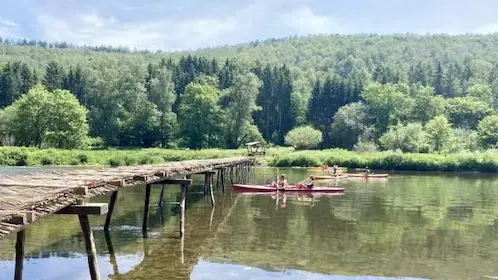
🚣 Kayak Descent & Pont de Claies
The woven bridge is one of the most iconic moments of a
kayak descent on the Semois. Passing under the woven structure,
hearing the wood creaking and seeing the walkers watching you from the deck —
a unique experience in Western Europe.
Kayak Semois Ardennes offers descents passing in front of Laforêt
from June to September (bridge season). Routes from Vresse-sur-Semois
or Alle-sur-Semois, starting at €17/person, shuttle included.
The bridge is installed every year in June (as soon as the Semois water level drops) and dismantled in September–October. Free and open access. Check the Semois water level before setting off.
How is the woven bridge built?
Exclusively wooden structure: oak/beech trestles in the rocky bed, beech/hornbeam stringers, and ~85 woven hazel panels. No nails or screws in the traditional version. Modern steel cables for safety in the event of a flood. Dimensions: ~80 m long, 1.40 m wide.
Is the woven bridge the only one of its kind?
Yes. It is the last representative of a technique once omnipresent in the Semois valley. A major ethnographic curiosity in Western Europe, listed in the Most Beautiful Villages of Wallonia and integrated into the Semois National Park.
Can you kayak and pass under the bridge?
Yes! Passing under the woven bridge in a kayak is one of the highlights of descents on the Semois. Kayak Semois Ardennes offers routes passing in front of Laforêt from June to September, starting at €17/person.
What is the Promenade des Légendes?
A marked 3.3 km (~1 hour) circuit departing from the center of Laforêt. It incorporates the woven bridge and mythical Ardennes figures: Pépé Crochet, the Nutons. Accessible to families. Explor Games (augmented reality) are available to enhance the visit.
What if the bridge is not yet installed during my visit?
If you come before June or after October, the bridge is dismantled. You can still enjoy Laforêt and the Promenade des Légendes on foot, as well as a kayak descent on the Semois (kayaking season: April–October depending on water level). Inquire at the Vresse-sur-Semois Tourist Office.
Experience the woven bridge from the water 🚣
Pass under the woven structure during a kayak descent on the Semois — a unique experience in Western Europe.
Ouvert tous les jours du 01/04 au 31/10. Fermé le 1er samedi de juin pour l'ouverture de la pêche.
Enter the information to see the rate…
Vos coordonnées
⚠️ You must accept the terms to continue.
Finaliser la réservation
🔒 Paiement 100% sécurisé via Stripe. Pour valider votre réservation, nous demandons les frais de plateforme (10%). Le solde sera à régler sur place chez notre partenaire. L'adresse précise et le nom du prestataire vous seront communiqués par e-mail juste après.
« A perfect family day on the Semois. The welcome at Kayak Semois Ardenne is warm, the equipment is spotless (the kayaks are modern and clean), and the free shuttle system is superbly organised. A must-visit in the Ardennes! »
A
Annelies Peeters G
« Beautiful kayak trip on the Semois starting from Vresse! Very friendly staff and excellent shuttle service. The riverside campsites along the Semois are also a must for nature lovers. »
P
Pierre-Yves Dubuisson G
« Superb 11 km kayak descent starting from Alle-sur-Semois. The wild nature of the Ardennes is magnificent in the spring sunshine. Very competitive prices compared to the competition. We'll be back! »
S
Sandra Müller G
« Wonderful experience! The kayak tour on the Semois was perfectly organised. The team is very helpful and speaks good German. The scenery of the Belgian Ardennes is simply breathtaking. »
D
Damien Claes G
« Excellent kayak rental service and great campsite on the banks of the Semois. The prices are very fair and the atmosphere is friendly and family-oriented. The little terrace bar is perfect for a refreshing drink after the effort. »
S
Sophie Mertens G
« A fantastic last-minute welcome even though we hadn't booked in the middle of August. Life jackets and waterproof barrels are provided free of charge. Very safe descents, ideal with children! »
T
Thomas Wright G
« Top-tier kayak rental on the Semois river. Extremely friendly staff, well-maintained kayaks, and a reliable shuttle. The viewpoints along the river are absolutely stunning. Highly recommend this local business! »