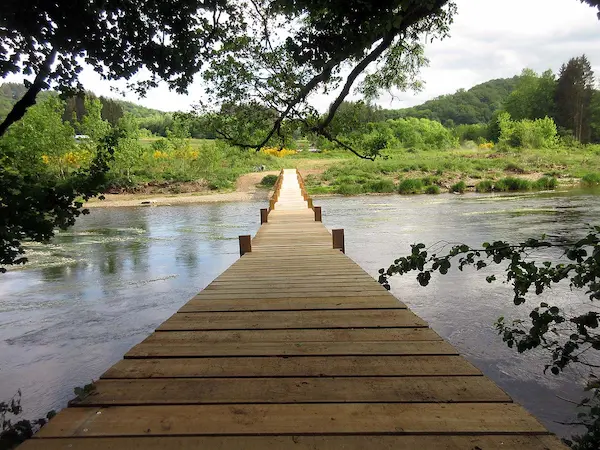
The Passerelle de Kelhan: a seasonal crossing at the heart of the Ardennes
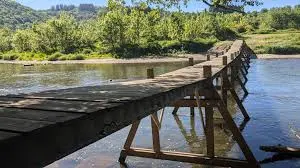
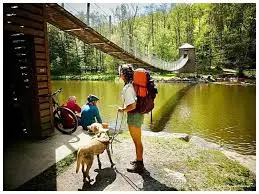
Between the villages of Bohan and Membre, in the municipality of Vresse-sur-Semois, the Semois winds through one of the last great wild meanders of the Belgian Ardennes. At the heart of this preserved landscape, a wooden cable-supported footbridge rises each summer above the river's green waters: the Passerelle de Kelhan, named after the Ardennes hamlet where it touches down on the left bank.
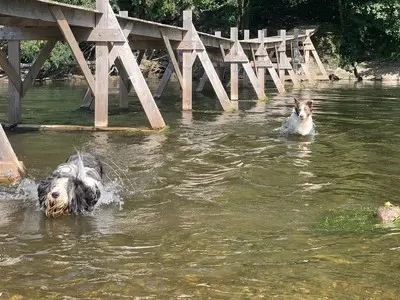
This lightweight structure, installed each year between late May and early autumn, is not intended to last. It is removed before the winter floods, allowing the river to reclaim its rights over the floodplain banks. This philosophy of the temporary — so deeply rooted in the Ardennes tradition of wattle bridges — lends the footbridge a special aura: it transforms a simple river crossing into a seasonal ritual, an appointment with nature at a very specific time of year.
The footbridge is the centrepiece of a 5.97 km hiking circuit that ranks among the most complete walks in the region: forest paths above the Sautou ravine, passage through the 220-metre railway tunnel built in 1935 for the National Society of Local Railways (SNCV), a stop at the ruins of the Broken Bridge of Bohan — a railway viaduct blown up in August 1944 — and a descent into the Bohan-Membre Nature Reserve, a biodiversity sanctuary managed by Ardenne & Gaume since 1949.
This guide offers a complete exploration of this exceptional territory: its railway history, geomorphology, natural heritage and the smuggling traditions that long animated these discreet woodlands between two porous borders. A way of going beyond the simple walk to read the landscape through the eyes of a geographer, a historian and a naturalist.
A seasonal footbridge: philosophy and heritage of the wattle bridges
In the collective imagination of the Ardennes, the river has long been both a boundary and a passage. Wattle bridges — those lightweight structures of lashed poles and axe-hewn planks — were until the mid-20th century the only way to cross the Semois in many places far from stone bridges. Built before the seasonal fairs and markets, they were dismantled after the flood season, then reassembled the following summer.
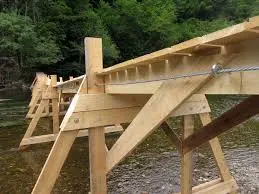
The Passerelle de Kelhan fits directly into this tradition. Its structure of steel cables and treated wooden decking — erected by a team of volunteers and technicians from the municipality of Vresse-sur-Semois — reproduces the ancestral gesture of the Ardennes man who "temporarily tames" his river. It is not there forever. Its absence in winter is as important as its presence in summer: it reminds us that the Semois, during floods, no longer belongs to humans.
The hamlet of Kelhan — a discreet place name known only to local residents — historically designated a meander of the Semois where boatmen and smugglers would stop. The name is probably of old Germanic origin (kel, running water + han, cock or crest), evoking the image of water that "sings" among the rocks. Here, between two tight bends of the river, the crossing imposed itself naturally as the most logical on the Bohan-Membre axis.
Today, the footbridge attracts hundreds of walkers every summer weekend. It has become a symbol of the sustainable tourism policy of Vresse-sur-Semois: a simple facility with minimal ecological impact, which values the landscape heritage without artifice. No giant car parks, no heavy infrastructure. Just the river, the wood, and the Ardennes forest that reasserts itself the moment you leave the marked path.
The Bohan-Membre Nature Reserve, which frames the circuit's route in its wildest sections, adds a dimension of silence and solemnity to the walk. Visitors expecting a standard tourist stroll are often surprised by the intensity of the experience: the murmur of the river, the darkness of the tunnel, the reflections of water on the stones of the Broken Bridge. The Passerelle de Kelhan is not just a way to cross the Semois — it is a landscape revealer.
The municipality of Vresse-sur-Semois offers other circuits in the same area. The green trail markers — official colour of the Kelhan circuit — are systematically double (on both sides of trees) to guide even inexperienced hikers. When in doubt, the rule is simple: never leave the markers in the ravine sections, where slopes exceed 30% and the clay soil becomes particularly slippery after rain.
The Kelhan circuit: topography and trail markings
The Kelhan circuit is a loop starting and finishing at the village of Bohan, accessible via the N95 national road linking Gedinne to Vresse-sur-Semois. The official starting point is the village car park, near the parish church. The recommended walking direction is clockwise: crossing the Semois via the footbridge first, climbing through the Kelhan forest, descending via the Sautou, and returning via the Broken Bridge. This direction maximises comfort and safety on the steep sections.
| Feature | Detail |
|---|---|
| Total distance | 5.97 km (loop) |
| Cumulative elevation gain | 156 m |
| Estimated duration | 1h30 to 2h (breaks included) |
| Difficulty | Medium — green trail markers |
| Starting point | Bohan car park (N95, 5550 Bohan) |
| GPS starting coordinates | 49.869° N, 4.924° E |
| Open season | Late May – late October (footbridge) |
| Accessibility | Not suitable for pushchairs / wheelchairs |
| Dogs | Allowed on leads in the reserve |
| Parking | Free in Bohan (limited capacity) |
The four key stages of the circuit
1. From the car park to the footbridge (0 to 1.2 km) — The path follows the right bank of the Semois upstream. The terrain is flat and easy, ideal for warming up. The first nature reserve signs appear, along with typical alluvial habitats of the lower valley: alders, willows and poplars in the riparian woodland.
2. The crossing and the Kelhan climb (1.2 to 2.8 km) — After crossing the footbridge (highlight of the circuit, panoramic views over the meanders), the path climbs quickly into the oak and beech forest of the left bank. The slope reaches 22% in places, on a dirt track. This is the most physically demanding part of the circuit, but it offers breathtaking glimpses over the valley.
3. The plateau and the Sautou ravine (2.8 to 4.4 km) — The path crosses a gently undulating forest plateau, then plunges into the Sautou ravine — a deeply incised valley with impressive slopes (up to 34% in places). Blocks of Ardennes schist emerge from the forest floor. The trail passes through "La Cheminée" (The Chimney), a narrow gap between two rock formations, where children particularly enjoy squeezing between the walls.
4. The Broken Bridge and the return (4.4 to 5.97 km) — The descent leads the hiker to the ruins of the Broken Bridge of Bohan: masonry piers of the SNCV viaduct blown up in August 1944. The path then follows the Semois downstream to the railway tunnel, before climbing back up to the village of Bohan to complete the loop.
The Bohan-Membre Nature Reserve: a biodiversity sanctuary
The Bohan-Membre Nature Reserve is one of the oldest reserves managed by the association Ardenne & Gaume, founded in 1949. It covers several dozen hectares on both banks of the Semois between Bohan and Membre, encompassing extremely varied habitats: calcareous grassland, heathland, rocky scree, slope forests, riparian woodland and alluvial banks. This mosaic of habitats gives the reserve exceptional biodiversity, recognised well beyond Belgium's borders.
335 lichen species and 19 new to Belgium
A lichenological study conducted in the reserve around the turn of the 21st century produced spectacular results: researchers catalogued 335 lichen species in the Bohan-Membre territory, including 19 species new to Belgium. This figure places the reserve among the most remarkable lichenological sites in Western Europe. Lichens — often regarded as minor organisms — are in fact excellent bio-indicators: their abundance and diversity bear witness to an air quality and ecological stability rare in a country as industrialised as Belgium.
Among the inventoried lichens, certain species grow only on old undisturbed substrates: pedunculate oaks more than two centuries old, Ardennes schist blocks sheltered from direct rain by natural overhangs. The presence of these intact micro-habitats in the reserve is a valuable indicator of the site's ecological continuity over several centuries.
The black stork, ambassador of the reserve
The Bohan-Membre reserve forms one of the foraging areas of the black stork (Ciconia nigra), which returned to nest in the Belgian Ardennes in 1989 after more than a century's absence. This emblematic species, supremely discreet, hunts bullheads and minnows in the cold, well-oxygenated forest streams that feed the Semois from the Ardennes plateau. The small tributaries of the Sautou ravine, sheltered by dense forest canopy, provide prime fishing habitats for this forest stork.
Hikers on the Kelhan circuit have a reasonable chance of spotting a black stork in flight above the wooded ridges, particularly in the early morning (between 7am and 10am) and late afternoon (after 5pm). Adults, recognisable by their glossy black plumage with green and purple sheen and bright red bill, often soar on thermals generated by the south-south-west facing wooded slopes.
Remarkable flora: orchids and wetland plants
The calcareous grasslands of the reserve — maintained by extensive grazing or late mowing — shelter several species of wild orchids: Dactylorhiza maculata (heath spotted orchid), Platanthera bifolia (lesser butterfly orchid) and, in the best exposed sectors, Gymnadenia conopsea (fragrant orchid). These small delicate flowers, which bloom between late May and mid-July, are one of the discreet yet striking spectacles that can be discovered by briefly leaving the marked path to observe the woodland edge grasslands.
The alluvial banks, regularly flooded during spring floods, host a vegetation of tall herbs adapted to wet habitats: wild angelica, hairy willowherb, Himalayan balsam (an expanding invasive species), and the dense stands of Petasites hybridus (common butterbur) that spread in spectacular carpets across the gravel bars.
The Ardenne & Gaume association regularly organises naturalist outings in the reserve, open to the public. These excursions, led by professional botanists and ornithologists, allow visitors to delve into the details of an ecosystem that a simple hike barely scratches the surface of. For the programme, consult the association's website directly.
The railway epic: SNCV Line 553
To understand the Membre-Bohan railway tunnel and the Broken Bridge, one must go back to the great adventure of the Belgian local railways, one of the most ambitious — and least known — engineering achievements in the history of rural Belgium. The National Society of Local Railways (SNCV), founded in 1884, had the mission of connecting the most remote Belgian countryside to transport — those areas not served by the ordinary SNCB railway network.
1913: the arrival of the steam tram in the Semois valley
SNCV Line 553 — known as the "Semois line" — was inaugurated in 1913. It connected Bertrix (SNCB railway hub) to Alle-sur-Semois, passing through Membre, Bohan and the villages of the Lower Semois. The steam locomotives that worked the line hauled mixed carriages carrying both passengers and goods essential to the local economy: quarry slate, construction timber, Semois tobacco, and foodstuffs for the landlocked villages.
Building the line was a considerable technical challenge. The deeply incised Semois valley forced engineers to bypass or pierce the rocky ridges. The SNCV engineers adopted an elegant solution for the most difficult section: the combination of a viaduct over the Semois and a tunnel under the ridge between Membre and Bohan.
1935: the 220-metre railway tunnel
The Membre-Bohan tunnel was bored in 1935, during a major modernisation of the line. 220 metres long, it was cut through Ardennes schist beneath the wooded ridge separating the two villages. Its horseshoe profile, characteristic of Belgian local railway tunnels from the interwar period, was dimensioned for the steam locomotives and short trains of the SNCV network.
The tunnel's construction employed several hundred workers for more than a year. The project used explosive boring techniques combined with a red brick lining, still perfectly visible today on the inner walls. This brick vault, slightly damp and moss-covered, is one of the first things hikers notice when they venture inside: it gives the tunnel an almost cathedral-like atmosphere, enhanced by the particular acoustics of the underground space and the sound of water filtering through the joints.
1940 to 1944: the line under Occupation
During World War II, Line 553 continued to operate under German control. It played a significant logistical role for the occupying forces in a region of strategic importance: the Franco-Belgian border ran close by in the Ardennes forests, and the woods offered resistance fighters natural refuges that motorised patrols could hardly control.
In August 1944, as liberation approached, Belgian and Allied forces decided to destroy railway infrastructure to impede the movements of retreating German troops. The SNCV viaduct over the Semois at Bohan — a multi-span metal structure — was blown up. The remains of these masonry abutments and piers, miraculously intact, are what today constitute the Broken Bridge of Bohan.
Post-war: the end of the local railways and conversion to a green trail
Line 553 never recovered from the destruction of its viaduct. The growing motorisation of the Belgian countryside, accelerated by post-war reconstruction, made rebuilding the bridge economically unviable. The line was permanently closed and its rails lifted in the 1950s. The former railway right-of-way gradually became a natural walking path — a forerunner of modern greenways — before being integrated into the official hiking circuits of the municipality of Vresse-sur-Semois.
The Broken Bridge of Bohan
Midway through the Kelhan circuit, the path opens onto one of the most photographed sites in the Semois valley: the Broken Bridge of Bohan. What you discover is not a bridge in the strict sense, but the ruins of a local railway viaduct destroyed in August 1944 during the Allied advance towards the German border.
The Ardennes schist masonry abutments and piers still stand proudly in and alongside the river, covered in vegetation — ferns, moss, ivy — that enhances the romantic ruin effect. The central piers, which once bore the metal spans of the viaduct proper, have partly sunk into the Semois. They emerge at low water (an improper term for a river, but it well illustrates the effect during summer low flows) like funerary monuments just above the water surface.
The site has been secured by the municipality of Vresse-sur-Semois: the most unstable piers have been consolidated, and a wooden viewing platform has been installed on the right bank to allow visitors to contemplate the entire structure safely. Educational panels explain the history of Line 553 and the destruction of the viaduct.
For kayakers paddling the Semois between Membre and Alle-sur-Semois, the Broken Bridge is an unmissable visual landmark. Glimpsed from the river, between two wooded meanders, it offers one of the most striking views of the lower Semois: a setting hovering between adventure novel and meditation on time.
Morning light (between 8am and 11am in summer) is ideal for photographing the Broken Bridge: the raking rays of the rising sun warm the schist stones and create dramatic contrasts between parts still in shadow and rock outcrops already bathed in light. For landscape photographers, this moment is worth the detour.
The Membre-Bohan Tunnel and the bats
The 220-metre railway tunnel is one of the most unusual elements of the Kelhan circuit. Hewn from Ardennes schist in 1935, it plunges the hiker into near-total darkness for one to two minutes of walking — long enough to trigger in children (and sometimes adults) a mild thrill of adventure. A torch or smartphone is strongly recommended, although some hikers choose to cross in complete darkness, guided only by the pinprick of light from the far entrance.
But the tunnel is not merely an architectural curiosity. Since the railway line closed in the 1950s, it has been a major hibernaculum for bats in the region. The near-constant temperature of the underground space (between 8 and 12°C all year), high humidity and permanent darkness make it an ideal refuge for wintering colonies.
Several species of protected bats have been inventoried in the tunnel, notably Barbastella barbastellus (western barbastelle), Rhinolophus hipposideros (lesser horseshoe bat) and Myotis bechsteinii (Bechstein's bat) — three species listed in Annexes II and IV of the European Habitats Directive and on Wallonia's mammal red list. During the hibernation period (November to March), access to the tunnel may be restricted by order of the Walloon Nature Agency (OWN) to protect the sleeping colonies.
In summer, bats use the tunnel as a daytime roost between nocturnal foraging flights. The attentive hiker may sometimes spot, in the early hours of dawn, a barbastelle or horseshoe bat hanging from the brick vault, just a few dozen centimetres above the ground. Basic rules of respect apply: do not shine powerful lights directly at the animals (hiking LED head torches are acceptable), do not disturb them or attempt to touch them.
The tunnel is also a remarkable habitat for cave-dwelling invertebrates and underground flora: several moss species adapted to darkness can be observed, wood-decay fungi on the rare remaining wooden sleeper remains, and a few troglophilic beetle species that entomologists regard as good indicators of the underground ecosystem's maturity.
The geomorphology of the Bohan-Membre basin
The Bohan-Membre area perfectly illustrates the complex geomorphology of the lower Semois valley in the Ardennes. The river, which flows over Devonian schist formations, carves here a succession of deeply incised meanders between wooded ridges culminating at 200–250 metres altitude. The height difference between the river bed (approximately 140 m) and the surrounding ridges creates very steep slopes, source of the spectacular scenery that gives the region its tourist reputation.
The Sautou ravine — which the Kelhan circuit crosses in its central section — is a characteristic example of the Ardennes hillside talwegs. Its slopes reach 34% in places, the physiological maximum for a path walkable without artificial aid. The ravine floor is traversed by a seasonal stream that carries, during heavy rainfall, schist and quartzite pebbles of great petrographic variety: so many witnesses to the glacial and periglacial phases that shaped the Ardennes relief during the Quaternary.
The passage known as "La Cheminée" (The Chimney) — a natural fissure in the schist wall through which the path squeezes — results from a frost-shattering process: water that had infiltrated a pre-existing crack froze repeatedly, progressively widening the joint until it created this picturesque passageway. This type of microrelief is characteristic of the Ardennes massif, where the Devonian metamorphic rocks display a pronounced schistosity that facilitates frost-induced splitting.
Semois tobacco and smuggling trails
It is hard to speak of the forests and paths of the Bohan-Membre region without evoking one of the most original rural industries of the Belgian Ardennes: the cultivation and processing of Semois tobacco. This exceptional tobacco, grown on small plots on the sunlit valley slopes, is the heir to an agricultural tradition dating back to the 17th century — a time when tobacco growing was both a vital economic resource and a semi-clandestine activity, subject to draconian fiscal monopolies.
The proximity of the Franco-Belgian border, which runs through the Ardennes forests a few kilometres south of Bohan, long made the region a favourite ground for smugglers. Tobacco — like gin spirits, salt and other goods taxed differently on either side of the border — travelled discreet forest paths, often at night, on the shoulders of men and women who knew every hollow, every path, every wattle bridge that could cross the Semois without being spotted.
The Belgian and French customs authorities carried out regular patrols in these woodlands. The smugglers, organised in small family networks, had developed sophisticated evasion techniques: use of sound codes (whistles, bird calls), relay points in isolated barns, and exploitation of unfavourable weather conditions — thick mist over the valley, fresh snow that muffled footsteps — to cover their tracks.
The Passerelle de Kelhan and its adjacent paths were among these smuggling routes. Local oral tradition reports that certain families from Bohan derived part of their income from the clandestine passage of tobacco and gin. These activities, criminalised by customs codes but deeply rooted in the social practices of the Ardennes community, were long perceived as a form of popular resistance to taxes deemed unjust.
Today, Semois tobacco is a protected Ardennes speciality produced by a handful of passionate artisans, the best known of whom are based in Corbion-sur-Semois. The artisan production involves ancestral drying, fermentation and toasting techniques that give the tobacco its characteristic notes of walnut and chocolate, appreciated by connoisseurs worldwide. The New York Times devoted a multi-page feature to it.
For the hiker making their way along the Kelhan circuit, these discreet paths between ferns and schist rocks still bear the imprint of this clandestine history. Some stepping stones, too regularly shaped to be natural, may well be remnants of dry-foot crossings built by smugglers. Another way of reading the landscape.
Practical information
Before you go
- Starting point
- Bohan car park (rue de l'Église), 5550 Bohan (municipality of Vresse-sur-Semois)
- By car
- N95 Gedinne–Vresse-sur-Semois, then D946 towards Bohan. GPS: 49.869° N, 4.924° E
- By public transport
- TEC bus line 8 (Dinant–Vresse), stop Membre; then 2 km on foot to Bohan via the N95
- Footbridge open
- Generally late May – late October (check with the Vresse town hall before setting out)
- Recommended footwear
- Waterproof hiking boots (trail or hiking) — clay soil and damp undergrowth
- Equipment
- Torch (tunnel), minimum 1 L water, light windproof jacket, sunscreen in summer
- Catering
- Café-restaurant in Bohan village (check seasonal hours). Picnic recommended
- Camping
- Riverside camping on the Semois at Alle-sur-Semois (15 km), or camping at Membre (summer season)
- Kayak combination
- Kayak departure from Bohan or Membre, arrival at Alle-sur-Semois possible on the same day. Ideal: morning hike, afternoon kayak.
- Emergencies
- Single number 112. Vresse-sur-Semois town hall: +32 (0)61 29 90 90
To combine this hike with a water experience, consider kayaking on the Lesse or a Semois paddle with our team based in Alle-sur-Semois. Both rivers, neighbouring and complementary, offer completely different atmospheres.
Book your stay on the SemoisPhoto gallery