★★★★★
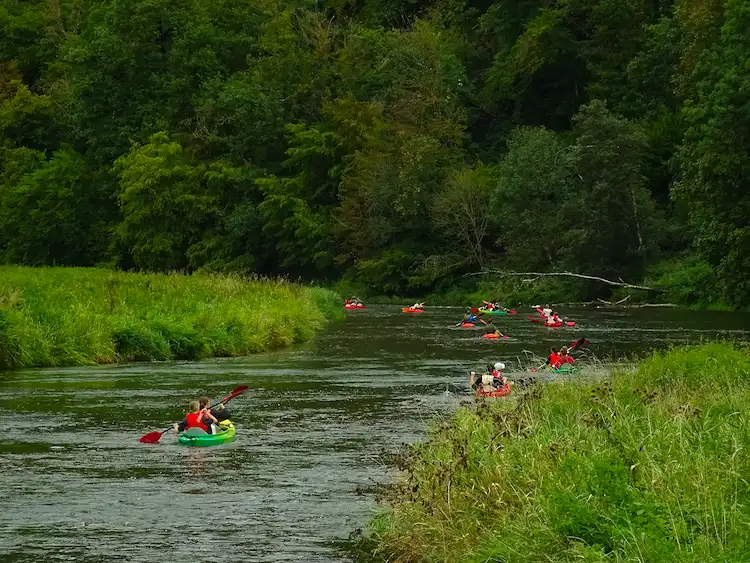
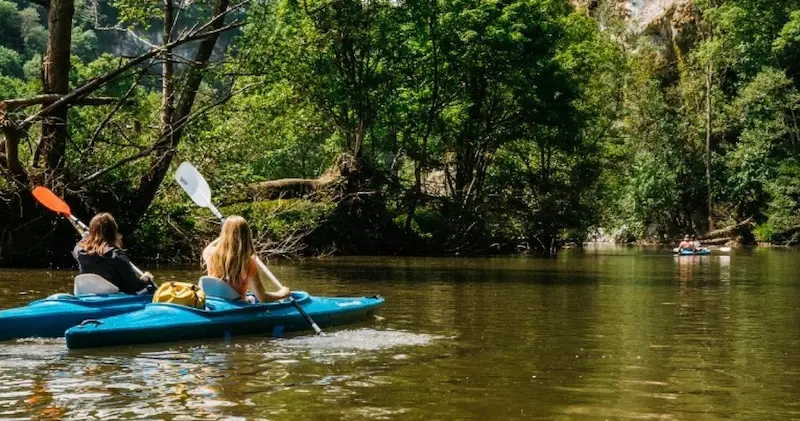
Very good, cheap and very friendly welcome. Thank you, because for my first time kayaking, I love it. I recommend it. See you next time 👍🙂
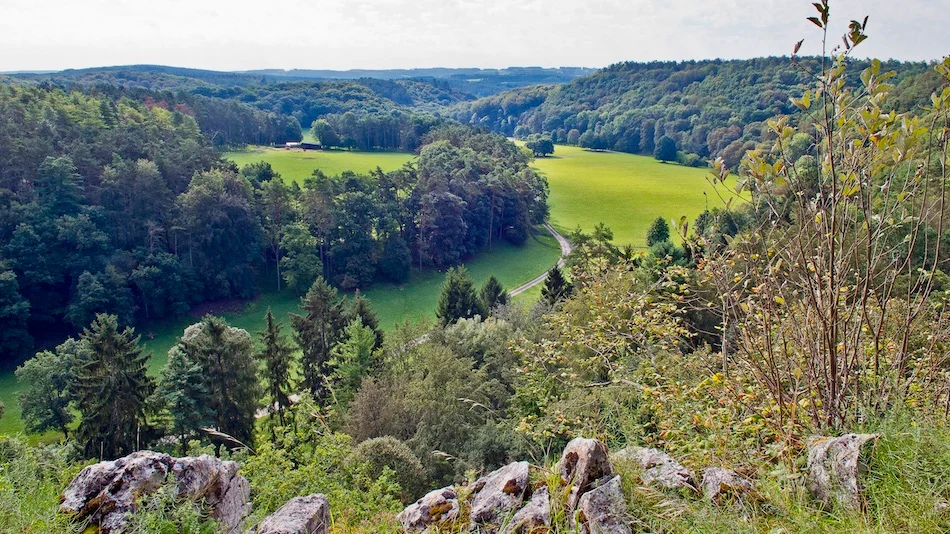
Jewel of the Calestienne: the most studied karst system in Belgium, a Wildlife Park unique in Europe (the only Belgian site with the 5 large animals roaming free), a century-old threatened vicinal tramway, and Neolithic artifacts hailing from the Italian Alps.
Audio Story · 5 min · French 🇫🇷
Han-sur-Lesse: Karst Ecosystem
Calestienne · UNESCO Global Geopark Famenne-Ardenne · Province of Namur
The village of Han-sur-Lesse crystallizes better than any other place in Europe the meeting between Devonian geological forces and human ingenuity. The Lesse, a fast-flowing river, plunges beneath the limestone wall at the Belvaux Chasm (vertical siphon down to -45m), traverses several kilometers of dark galleries formed by phantomization, and then spectacularly resurfaces at the Trou de Han.
This unique hydrogeological system in the world is today the subject of intensive research by the University of Namur (since 2004) and is fully integrated into the UNESCO Global Geopark Famenne-Ardenne. It attracts ~500,000 visitors per year to a village of just a few hundred inhabitants.
"Han-sur-Lesse stands as an essential laboratory where the global conservation of Europe's terrestrial, environmental, and industrial memory is considered."
Photographic documentation
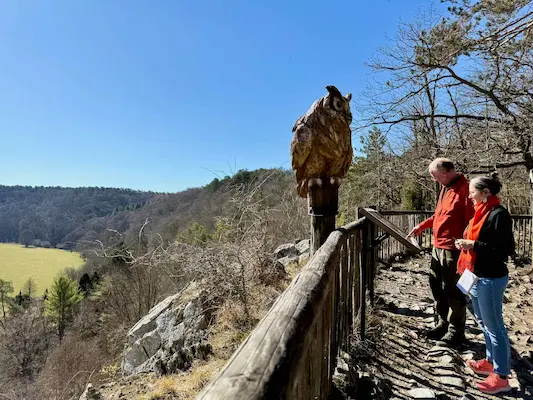
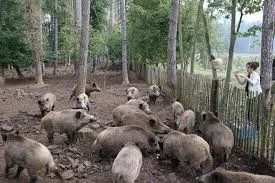
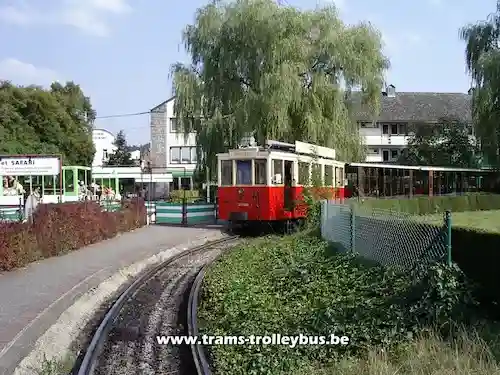
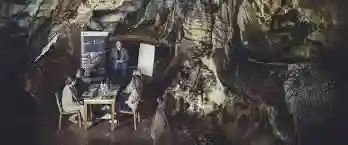
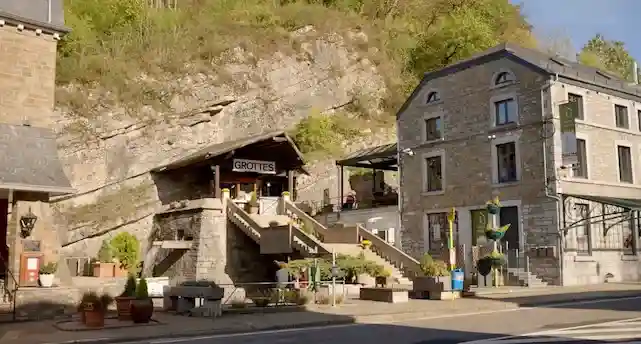

🪨 Devonian · Phantomization · UNESCO Geopark · University of Namur
For a long time, it was believed that the caves resulted from simple mechanical erosion by the river. Contemporary karstology research has shown that the process is infinitely more complex and takes place in two silent and successive stages.
Phase 1 · Isovolumetric dissolution (silent)
Phase 2 · Mechanical evacuation (spectacular)
Karst sites of the Han system
🔬 Scientific research – University of Namur (since 2004)
⚗️ Excavations since 1963 · Transcontinental networks · Votive practices
Excavations of the aquatic deposits in the Cave of Han (since 1963) have overturned the view of prehistoric populations being isolated. Han-sur-Lesse was a hub of trans-European exchange networks more than 5,000 years ago.
| Artifact | Geographic origin | Dating | Significance |
|---|---|---|---|
| Polished axes in eclogite (Puy type) | Monte Viso, Italian Alps (1800-2450m) | 3800-3600 BC | Markers of ostentatious social prestige. Spread via trans-European networks. Secondary reuse attested: omphacitite heel converted into a potter's burnisher (flattened "D" section wear). |
| "Chocolate bar" (large brown Oligocene flint blade) | Largue Valley, Forcalquier, SE France | From 3500 BC | Lever pressure flaking · 30 cm blades · mounted as daggers · massive diffusion as high technological value objects |
| Notched scrapers (including one with 4 notches – exceptional) | Local / regional flint – Gord Group | 2800-2700 BC | Statistically unusual. Precise cultural markers of the Belgian Late Neolithic |
| Arrowheads (SOM cultures + Gord Group) | Knapped flint – local production | Late Neolithic | Morphological diversity: lozenge-shaped (SOM), tanged and barbed (Gord). Cultural superimposition. |
Sources: Notae Praehistoricae 31 (Royal Belgian Institute of Natural Sciences) · University of Namur
The accumulation of imported wealth (Alpine axes, Provence blades, ornaments, and daggers) in a hostile subterranean aquatic environment, far from settlement areas, strongly suggests a cultic function for the cave. These deposits could result from votive practices: goods of the highest value sacrificed and thrown into the dark waters of the subterranean Lesse to attract the favor of chthonic deities — a common practice in late Prehistoric rituals.
~1700
Legend of the Companions of the Hole
Tradition reports the use of the dark halls as a bandits' lair. Scientifically confirmed: soot traces dated in stalagmitic formations.
Late 18th c.
First paid guided tours
Inhabitants of Han offer tours of the entrance gallery. Formal commercial structuring around 1815.
Sept 6, 1966
Destreilles & Lefèvre (S.S.N.)
First exploratory dive at Belvaux Chasm with telephone link (laryngophone + safety line). 75 m of flooded gallery explored. Returned at the limit of their air reserve.
2019
SCUCL Connection
The UCL Speleo Club achieves the total physical connection of the network sections after decades of clearance work.
2023
1st historical traverse + South Network
First complete traverse from Belvaux Chasm to the Trou de Han. Simultaneous discovery of about a hundred meters of virgin galleries in the "South Network".
🚃 Vicinal heritage · Line 521/2 · Royal decree 1905 · 2026 Crisis
Known under the designation of line 521/2 or 974, this 5.4 km meter-gauge vicinal railway epitomizes the evolution of tourist transport over more than a century. Created by royal decree in 1905, opened on June 1, 1906 under the initiative of Edouard de Pierpont.
Steam Era (1906-1934)
HL type steam locomotives. Some kept in backup service until 1957.
Sherman Motorization (1934-2014)
Thermal railcars (ART90, AR145, AR159, AR168, AR266). 2-stroke, 6-cylinder, 220 hp GM-Detroit Diesel engines — military surplus derived from WWII Sherman tank engines. Note: AR145 not converted to electric (incompatible automatic transmission).
Electric Transition (2014-present)
AR145, AR266, 89 and 159 converted to 100% electric. Full overnight charge + quick top-ups between rotations. Passenger cars: open wagons built in the 1990s, exact replicas of the 1895 original blueprints, with compressed air brakes.
⛔ 2026 CRISIS – Cessation announced
The operator announces definitive cessation for 2026. Legal imbroglio: the infrastructure (rails, rights-of-way) and rolling stock legally belong to TEC (SNCV inheritor). National petition by historian Marc Hélin: "ruthless destruction of an invaluable common good, born from the will of Edouard de Pierpont." Threatens 400,000 visitors/year to rue des Grottes and dozens of businesses.
If alternatives (such as a gondola with an off-center departure) were adopted, pedestrian flows would be diverted away from rue des Grottes. Consequence: severe commercial devitalization of the town center, threatening the survival of dozens of merchants, souvenir shops, artisans, and restaurateurs who currently depend on the 400,000 visitors/year.
🐺 250 ha · Created 1970 · Only site in Belgium · European Big Five
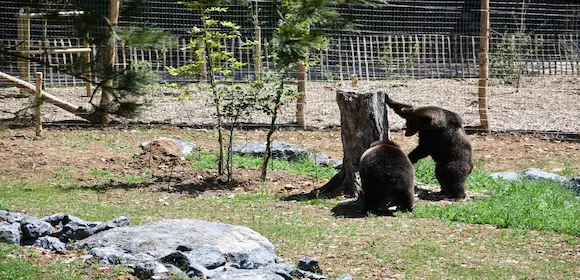
Created in 1970, the Wildlife Park covers 250 hectares of forest on the Massif de Boine as well as the Chavée (a valley dried up by the subterranean diversion of the Lesse). With 650 animals of 36 species in preserved semi-wild biotopes, Han is the only park in Belgium where the general public can observe the European Big Five simultaneously.
Brown bear
Ursus arctos
Bear Hill (2 ha created 2019) · Björn, Olof and Jojo
Arctic wolf
Canis lupus arctos
Lives in a pack · high environmental resilience
European bison
Bison bonasus
Reintroduction program in Eastern European forests
Lynx
Lynx lynx
Feline of European forests · dense cover in Massif de Boine
Wolverine
Gulo gulo
Boreal mustelid rare in captivity · Palearctic fauna
🏰 Abbey of Saint-Hubert · Provostry of Revogne · Limestone architecture
The classic Famennian limestone farm can be observed on rue des Grottes. Immutable tripartite organization: main house (heated human living space) · barn door (very wide base and significant elevation for high hay carts) · stable (livestock).
The flared morphology of the barn door was not an aesthetic choice but an absolute logistical necessity: to hastily gulp down massive cartloads of hay vital for wintering animals, without hitting the lintels.
Venerable linden tree in front of the 1905 church portal, studded with hundreds of rusted forged nails. A ritual for healing toothaches: rub a nail on the decayed tooth, hammer it into the tree — the pain transmitted and "nailed" into the linden's fibers. Analogous animist practice to Provins (Île-de-France) and Bonnœuvre (Loire-Atlantique).
Preserved facing the modern tourist ticket offices — a testament to the strong resilience of the Calestienne's folkloric fabric.
🍺 Saison Beer · Great Fire · Brotherhood of Han · Bistrot de Terroir
The "Saison" type beer (not to be confused with Christmas or Easter beers) is a creation of pre-industrial meteorological constraints. Since it was impossible to brew in summer (bacterial proliferation without refrigeration), farmers brewed in winter. These Saisons then underwent a long aging process in naturally cold limestone caves, developing a characteristic aromatic complexity and sweet-and-sour flavors — ideal for the summer harvest workers. Defended by the Brotherhood of Han-sur-Lesse (chapters on the 4th Saturday of April in odd years).
Annual festivity between mid-March and early spring (March 14 or 21). Archaic practice with pre-Christian origins observed in Han-sur-Lesse, Lavaux-Sainte-Anne, Lessive, Sorée, Havrenne and Waha. The ritual follows a precise dramaturgy: erection of a monumental branch bonfire topped with the "winter snowman" (scapegoat), torchlight procession, costume contest, then burning around 8 PM. The destruction of the effigy symbolically marks the triumph of vernal light over darkness.
Le Pavillon restaurant of the Cave Domain has obtained the official "Bistrot de Terroir" label — promoting regional producers (short supply chains in the Ardennes, Calestienne, Famenne). The Han 1900 Museum (14 rue des Grottes, curator Dimitri Hayon) reconstructs 85 scenic early 20th-century tableaux with 150 costumed mannequins, authentic tools from forgotten trades (blacksmith, cobbler, teacher), and a gallery of regionalist painters. Total LED energy renovation in line with Geopark values.
🗺️ Organization · Full day · 7 hours
Arrive early – park at the central lot
Arrive by 9 AM to avoid lines at the counters (facing the 1905 church, Place Théo Lannoy). Take the opportunity to observe the Nail Tree (linden with hundreds of forged nails). Rue des Grottes comes alive as soon as the tramway arrives.
Take the vicinal tramway (line 521/2)
3 departures/hour · 120 passengers/convoy. The current electric railcars (converted 2014) transport you to the cave entrance. A must-do priority in 2025-2026: closure is announced for 2026 (TEC/property dispute). A convoy is 1 railcar + 3 1895 replica open cars with compressed air brakes.
Visit the caves (2h)
Dry galleries then boat ride on the subterranean Lesse to the Trou de Han resurgence. Observe the Grandes Salles formed by Devonian phantomization, the 5-10 mm diameter stalactites. Think about the Neolithic excavations since 1963 in the Fountains Galleries.
Wildlife Park (3h minimum)
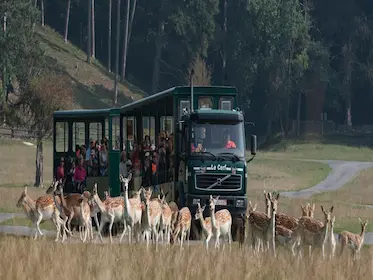
250 ha · Safari-cars · European Big Five. Ideal moment: deer rut in autumn. Observe brown bears (2 ha Bear Hill, Björn/Olof/Jojo), Arctic wolf, European bison, lynx, wolverine. Przewalski's horses and griffon vulture.
Han 1900 Museum + Bistrot de Terroir lunch
14 rue des Grottes: 85 scenic tableaux, 150 costumed mannequins, authentic tools. Lunch at Le Pavillon (Bistrot de Terroir label) with local Saison type beer (brewed in winter, aged in a limestone cave).
❓ Frequently Asked Questions · Han-sur-Lesse · Caves · Park · Tramway
The caves of Han result from a two-step process known as "ghost-rock phantomization." First, subterranean isovolumetric dissolution: water infiltrating the Devonian limestone faults slowly dissolved soluble minerals, leaving a residual porous structure (the alterite or "ghost rock") that retained the volume and appearance of the rock. Later, tectonic movements caused an uplift of the limestone plateau. The water, with increased kinetic energy, mechanically washed away this loose alterite, creating the colossal halls seen today (Trou du Salpêtre, Verviétois Gallery, Grandes Salles). The University of Namur has been conducting intensive research on this site since 2004 via STREAM probes from the company Traqua.
The Belvaux Chasm (Gouffre de Belvaux) is the major hydrogeological loss of the Han system: the Lesse river abruptly disappears under the Devonian limestone wall through a vertical siphon plunging 45 meters deep into the Massif de Boine nature reserve. In 1966, diver-speleologists Bob Destreilles and Jean-Marie Lefèvre explored this chasm using a laryngophone telephone link. In 2019, the SCUCL (Speleo Club of UCL) achieved the complete connection of the network's sections. In 2023, they accomplished the very first integral traverse from Belvaux to the Trou de Han. Also in 2023, the SCUCL discovered about a hundred meters of virgin galleries in the "South Network".
Since 1963, excavations of aquatic deposits (bed of the subterranean Lesse, Gallery of the Fountains) reveal that Han-sur-Lesse was a hub of transcontinental networks as early as the Late Neolithic. Major discoveries: (1) Polished axes in eclogite and omphacitite from Monte Viso and Monte Beigua (Italian Alps, 1800-2450m altitude), Puy type, dated 3800-3600 BC — markers of social prestige, one reused as a burnisher; (2) "Chocolate bar": large blade of zoned brown Oligocene flint from the Largue valley (Forcalquier, SE France), lever pressure flaking technology (30 cm blades, from 3500 BC); (3) Scrapers from the Gord Group (2800-2700 BC) including an exceptional one with 4 notches; (4) Arrowheads from SOM cultures and the Gord Group. The accumulation of precious objects in a hostile subterranean aquatic context suggests chthonic votive practices.
The Caves of Han tramway (line 521/2 or 974) is a 5.4 km meter-gauge vicinal railway, created by royal decree in 1905 and opened on June 1, 1906, under the impulse of Edouard de Pierpont. It has seen 3 eras: HL steam (1906-1934), thermal railcars with GM-Detroit Diesel engines from WWII Sherman tanks (1934-2014), and then 100% electric battery traction (2014-present). Each convoy (1 railcar + 3 open 1895 replica cars) transports 120 passengers, 3 departures/hour. In 2026, its definitive cessation was announced: the infrastructure and rolling stock legally belong to the TEC (inheritor of the SNCV), creating an insoluble legal imbroglio. Consequence: 400,000 annual visitors currently using the rue des Grottes via the tramway would be diverted, threatening dozens of local businesses.
Created in 1970, the Han Wildlife Park covers 250 ha (forest + Chavée, a valley dried up by the subterranean diversion of the Lesse). It houses ~650 animals of 36 species in semi-wild biotopes. Han is the only park in Belgium gathering the European "Big Five": brown bear (2 ha Bear Hill, created 2019, including Björn, Olof, and Jojo), Arctic wolf (in a pack), European bison (reintroduction program in Eastern European forests), lynx, wolverine. Additionally: Przewalski's horses (reintroduction), griffon vulture, red deer (autumn rut), and >2,000 plant species. Managed in collaboration with the Department of Nature and Forests (DNF) and Natagora.
The Nail Tree (Arbre à Clous) is a venerable linden tree on Place Théo Lannoy (facing the cave ticket office) whose trunk is studded with hundreds of rusted forged nails. This ritual of rural superstitious medicine involved rubbing a nail against a decayed tooth and then hammering it into the tree's bark, which was supposed to absorb the pain and infection. An analogous animist practice is observed in Provins (Île-de-France) and Bonnœuvre (Loire-Atlantique). The tree, preserved opposite modern tourist counters, testifies to the strong resilience of the Calestienne's folklore fabric.
The "Saison" type beer (not to be confused with Christmas or Easter beers) is a brewing tradition of the Famenne region defended by the Brotherhood of Han-sur-Lesse (chapters on the 4th Saturday of April in odd years). In the past, since drinking water was a disease vector, beer provided safe hydration for summer agricultural workers. Since brewing was impossible in summer (bacterial proliferation without refrigeration), these "Saisons" were brewed in winter and then kept in long storage in the region's limestone caves. This natural cold gave the liquid a characteristic aromatic complexity and sweet-and-sour flavors. Le Pavillon restaurant at the Cave Domain obtained the "Bistrot de Terroir" label for highlighting this local heritage.
The Benedictine Abbey of Saint-Hubert profoundly structured the region. As early as the Early Middle Ages, thanks to royal donations (Carloman to the Stavelot monastery in 747), it extended its hold over the Famenne. In the 12th century, it founded the village of Neuvillers ("new village", whose inhabitants are nicknamed "les tchèts d'Nuviè") from scratch. In 1658, the monks built a large farm at the village entrance to collect agricultural tithes (still visible). In 1586, the priest and administrators of Ochamps rebelled against the illegal construction of the Goutelle mill by the local mayor — a sign of the absolute strategic value of the pre-industrial hydraulic energy of the Lesse.
In 2023, the Speleo Club of the Catholic University of Louvain (SCUCL) achieved the very first "historic", complete, and uninterrupted traverse of the Massif de Boine: entering through the Belvaux Chasm and exiting via the Trou de Han. This was made possible by the total physical connection of the network's sections, accomplished in 2019 after decades of clearance work. That same year in 2023, the SCUCL discovered about a hundred meters of virgin galleries in the "South Network", demonstrating that the massif's exploratory potential remains immense.
Yes. Han-sur-Lesse is integrated into the UNESCO Global Geopark Famenne-Ardenne, which highlights the global scientific and heritage importance of the Calestienne karst ecosystem. The site has been researched by the University of Namur since 2004 focusing on karst aquifers (underground water tables in fractured limestone rocks — highly vulnerable to surface pollution due to the lack of slow filtration). Cutting-edge technologies (STREAM probes by Traqua) now allow for fine monitoring of flows in this complex hydrogeological system.
🪨
Devonian karst caves · European Big Five (only Belgian site) · 1906 vicinal tramway (experience it in 2025 before the 2026 threat) · Neolithic archaeology · Saison Beer · Nail Tree · ~500,000 visitors/year
Very good, cheap and very friendly welcome. Thank you, because for my first time kayaking, I love it. I recommend it. See you next time 👍🙂
Contrary to other published opinions, we were very well received, the team is very friendly and the kayak rental is cheaper here than elsewhere. We recommend Kayak Ardenne!
Fantastic campsite, affordable prices and adorable staff!
Top, very friendly and good service. Correct prices.
We stayed 1 night in a tent and did the 11km kayak descent. Helpful and super friendly staff. Perfect organization for arrival on the Semois and reception after the descent. Thanks for everything!
We were able to enjoy this day thanks to the lady at the kayak bar! Without knowing it, we hadn't booked. She found a last minute solution! Top thanks again!
Excellent kayak rental on the Semois. Different routes possible for short or long distance depending on the wish. The staff is very friendly and advises you perfectly!
Magnificent canoe descent (17km), the service is very good, we wait little even at arrival thanks to the driver and his wife. In addition, the small cafe with terrace is very pleasant.