Jean-Luc Demaret G
« A perfect family day on the Semois. The welcome at Kayak Semois Ardenne is warm, the equipment is spotless (the kayaks are modern and clean), and the free shuttle system is superbly organised. A must-visit in the Ardennes! »
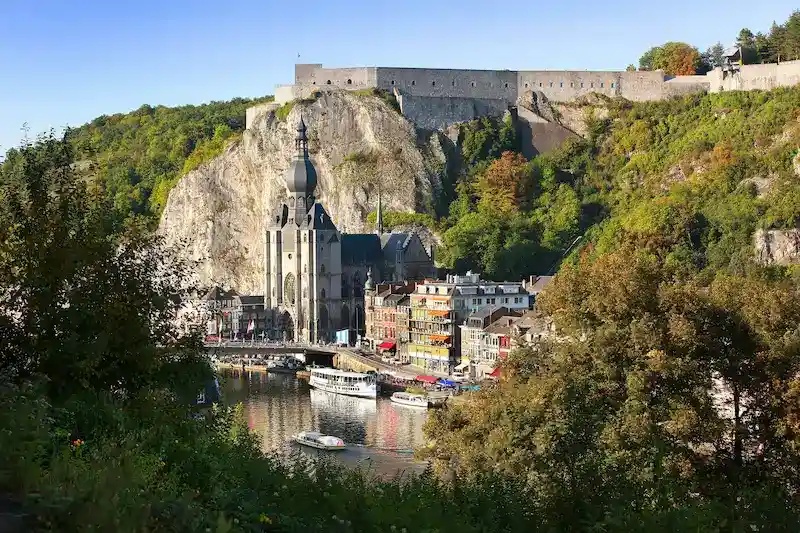
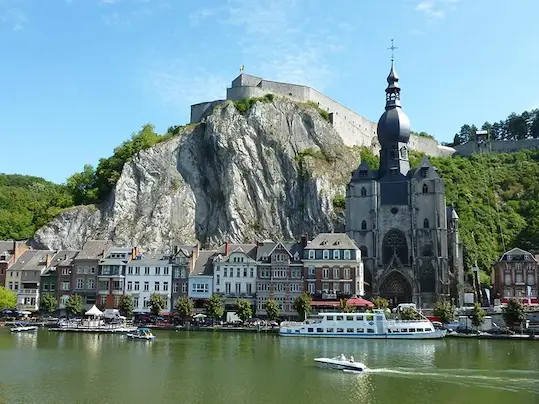
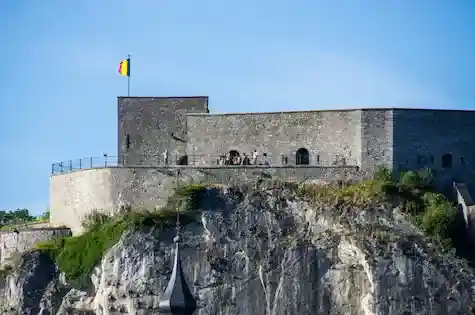
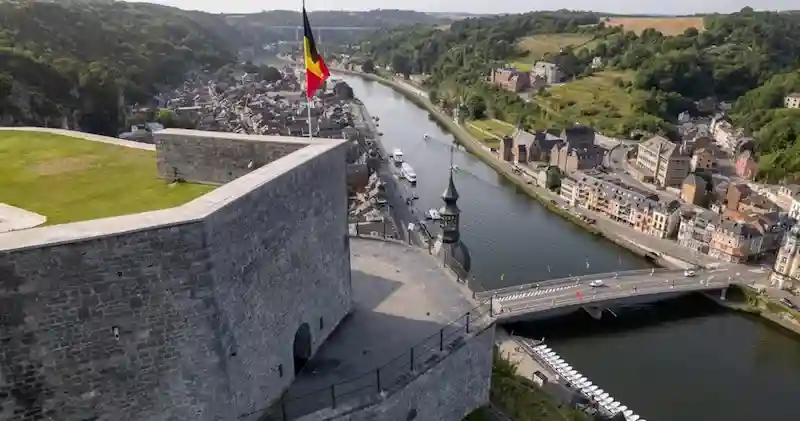
Perched 100–120 meters above the Meuse on a breathtaking rocky spur, the Dinant Citadel crystallizes nearly a millennium of European geopolitics: medieval brassware, the Burgundian apocalypse, Vauban's genius, Bergsma's Dutch pentagon, the 1830 revolution, and the double assaults of 1914 and 1940.
Meuse fortress · Exceptional heritage of Wallonia
The Dinant Citadel occupies a rocky spur 100–120 meters above the Meuse, commanding one of the most strategic penetration axes in North-West Europe. Its position conditioned the destiny of all continental powers: the Principality of Liège, Dukes of Burgundy, Kings of France (Henry II, Louis XIV), Vauban, United Kingdom of the Netherlands, the German Empire, and the Third Reich.
Dinant's economy relied on brassware (dinanderie) — copper and brasswork — a proto-industry exporting its liturgical and domestic products to London as early as the 13th–14th centuries. The citadel was its indispensable shield, protecting trade flows to the North Sea.
"The citadel of Dinant cannot be limited to a simple nomenclature of stones, curtain walls, and ramparts; it requires a systemic understanding of how the unique topography dictated the military, economic, and social destiny of the town throughout the centuries."
| Period | Dominant power | Key event |
|---|---|---|
| 1040–1080 | Principality of Liège (Bishop Nithard) | Primitive edification – control of the bridge and Meuse toll |
| 13th–15th c. | Principality of Liège (Holy Roman Empire) | Protection of brassware – exports to London |
| August 1466 | Duchy of Burgundy (Charles the Bold) | Total sack – 30,000 men – town burned, 11 years in ruins |
| 1554 | Kingdom of France (Henry II) | Capture of the castle by Gaspard de Coligny (Italian Wars) |
| 1675–1698 | Kingdom of France (Louis XIV / Vauban) | Bastioned modernization – Maintenon's carriage – Treaty of Ryswick |
| 1818–1821 | United Kingdom of the Netherlands (Bergsma) | Current polygonal pentagon – 400 soldier garrison |
| October 1830 | Belgian Revolution | Capitulation of the Dutch garrison (deprived of water) |
| 1859–1878 | Kingdom of Belgium | Military decommissioning and private buyout for 6,100 francs |
| 1914 | WWI Frontline | De Gaulle wounded at the bridge – 674 civilians massacred |
| 1940 | Third Reich | Attack by Rommel's 7th Panzer Division |
| Today | Museum / Citadelle de Dinant S.A. | UE5 HistoPad – 300-person MICE events |
9 exclusive photos

📜 Geopolitical and military analysis · 1040–2026
Every century has left its mark on the Dinant rock. From Bishop Nithard's primitive fortress to the Bergsma bastions via Vauban's genius, here is the exhaustive chronology of a unique site in Europe.
1040–1080
Construction driven by the need to protect the southern margins and the bridge over the Meuse. Objective: physical and fiscal control of the Meuse crossing and protection of the nascent brassware industry.
Bridge control + toll13th–14th century
Dinant's economy radiated across Northern Europe thanks to copper and brass work. The city had a commercial hall and customs privileges in London. The citadel was the indispensable shield of this global economic hub.
Commercial hall + London privilegesAugust 1466
30,000 men under Charles the Bold. Siege from August 17 to 25. Capitulation on August 25. Pillaging, civilian executions (thrown into the Meuse), total fire. Fortress razed. 11 years of ruins.
30,000 men · Town burnedJuly 1554
During the 10th Italian War, the troops of the King of France Henry II seized the castle after a four-day siege, forcing the Spanish commander to surrender.
Italian Wars1577
Aware of the difficulty of supplying the garrison, engineers had 408 steps carved directly into the limestone rock, connecting the back of the choir of the Collegiate Church of Notre-Dame to the southern posterns of the citadel.
408 steps – limestone rock1675–1698
In 1675, a victorious French siege by Marshal François de Créquy against a German garrison. Vauban completely redesigned the defenses. In 1692, Louis XIV set up his court (Maintenon's carriage). In 1697, the Treaty of Ryswick forced France to destroy its own bastions before evacuating.
Vauban + Maintenon carriage1818–1821
As part of the Wellington Barrier, Captain Eiso Bergsma designed a polygonal fort. Planned garrison: 400 soldiers. 90 m water chain (1818-1820) replaced by a well drilled into the rock in 1840.
Bergsma pentagonOctober 2, 1830
Following the fighting in Brussels, Dinant volunteers blockaded the fortress. Totally deprived of water, Major de Venne's Dutch garrison capitulated, two days before the proclamation of independence.
Dutch capitulation1859–1878
Modern artillery rendered the walls obsolete. Decommissioned in 1859, the fortress was resold on November 11, 1878, for 6,100 Belgian francs to private buyers before becoming the town's flagship attraction.
Tourism pioneerAugust 1914
August 15: capture of the citadel. Lieutenant Charles de Gaulle was wounded at the bridge. August 23: systematic massacre of 674 civilians, 80% of urban fabric destroyed.
De Gaulle wounded · 674 victimsMay 1940
The tanks of the 7th Panzer Division led by Erwin Rommel crossed the Meuse at Leffe and took the citadel under the fire of their artillery.
Rommel's PanzersThe art of working non-ferrous metals (copper, brass), Dinant's brassware radiated across Northern Europe. It had customs privileges in London as early as the 13th–14th centuries, testifying to its status as a first-rate merchant power.
The citadel was its shield: it guaranteed the security of raw material import flows and the lucrative export of finished products to the North Sea. The Sack of 1466 deliberately wiped out this skilled workforce, dispersing them in exile for 11 years.
Louis XIV dispatched his most illustrious military engineer to completely rethink the defensive system. Vauban added glacis, demi-lunes, and oversaw the construction of a new castle. In 1692, Louis XIV set up his court in Dinant – the carriage of Madame de Maintenon is preserved at the citadel. In 1697, the Treaty of Ryswick forced France to demolish its own bastions – one of the rare times a State destroyed its own military masterpiece.
⚔️ August 17–29, 1466 · Wars of Liège
The bourgeois of Dinant, galvanized by false rumors of Burgundian defeat, publicly insulted the Count of Charolais (the future Charles the Bold) by calling him a bastard and hanging his effigy from the ramparts. The Principality of Liège, diplomatically isolated by the Treaty of Arras (1435) and weakened since the battle of Othée (1408), excluded Dinant from the amnesty clauses of the Peace of Sint-Truiden.
Charles set up his HQ at Leffe Abbey. His father Philip the Good observed from Bouvignes, on the opposite bank. Bombards pounded the Saint-André gate. The capitulation on August 25 opened 2 days of pillaging, executions (civilians thrown into the Meuse) and fire. The fortress was razed stone by stone to prevent any future rebellion.
🏗️ 1818–1821 · Wellington Barrier · Captain Eiso Bergsma
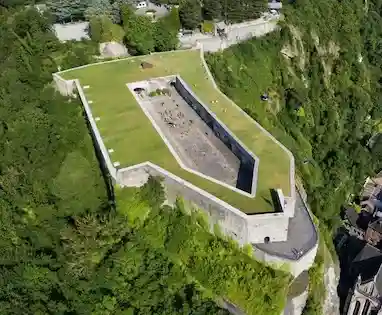
The citadel you see today is neither the work of the Liégeois nor Vauban, but of a post-Napoleonic Dutch military engineer, as part of a European program funded by the United Kingdom.
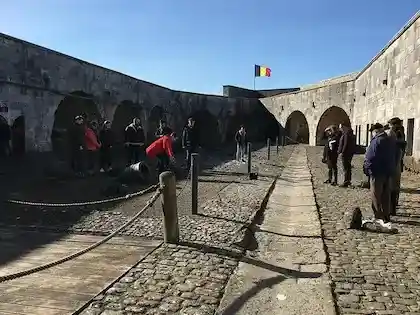
Breaking with Vauban's star-shaped bastions, Bergsma opted for polygonal fortification. The fort adopts an elongated horseshoe plan, following the steep contours of the rocky peak. The defensive effort is asymmetrical: powerful artillery-mounted semi-circular bastions are concentrated towards the south-east, a point of tactical vulnerability where the relief softens.
Pentagon · Horseshoe · 1818–1821Planned garrison: 400 soldiers. Problem: water. Phase 1 (1818–1820): a vertical supply chain of 90 meters hoists water from the Meuse via pulleys. It was the destruction of this system that forced the garrison to surrender in 1830. It was replaced in 1840 by a gigantic well drilled through the limestone rock.
90 m chain · Well drilled 1840In 1577, engineers had 408 steps carved directly into the limestone rock to connect the back of the choir of the Collegiate Church of Notre-Dame to the south flank posterns of the citadel. A direct, covered, and secure logistical connection to quickly supply the garrison in case of surprise attack.
408 steps · Carved in rockThe main entrance, framed by its casemates, features a lintel engraved with a direct message to the defeated French: "Ni circumspicias. Aggrediare cave. Anno VI post proelium ad Waterloo" ("If you are not careful, beware of being attacked. Sixth year after the battle of Waterloo", 1821).
Post-Waterloo warning🥽 Heritage technology · Histovery × Dinant Citadel
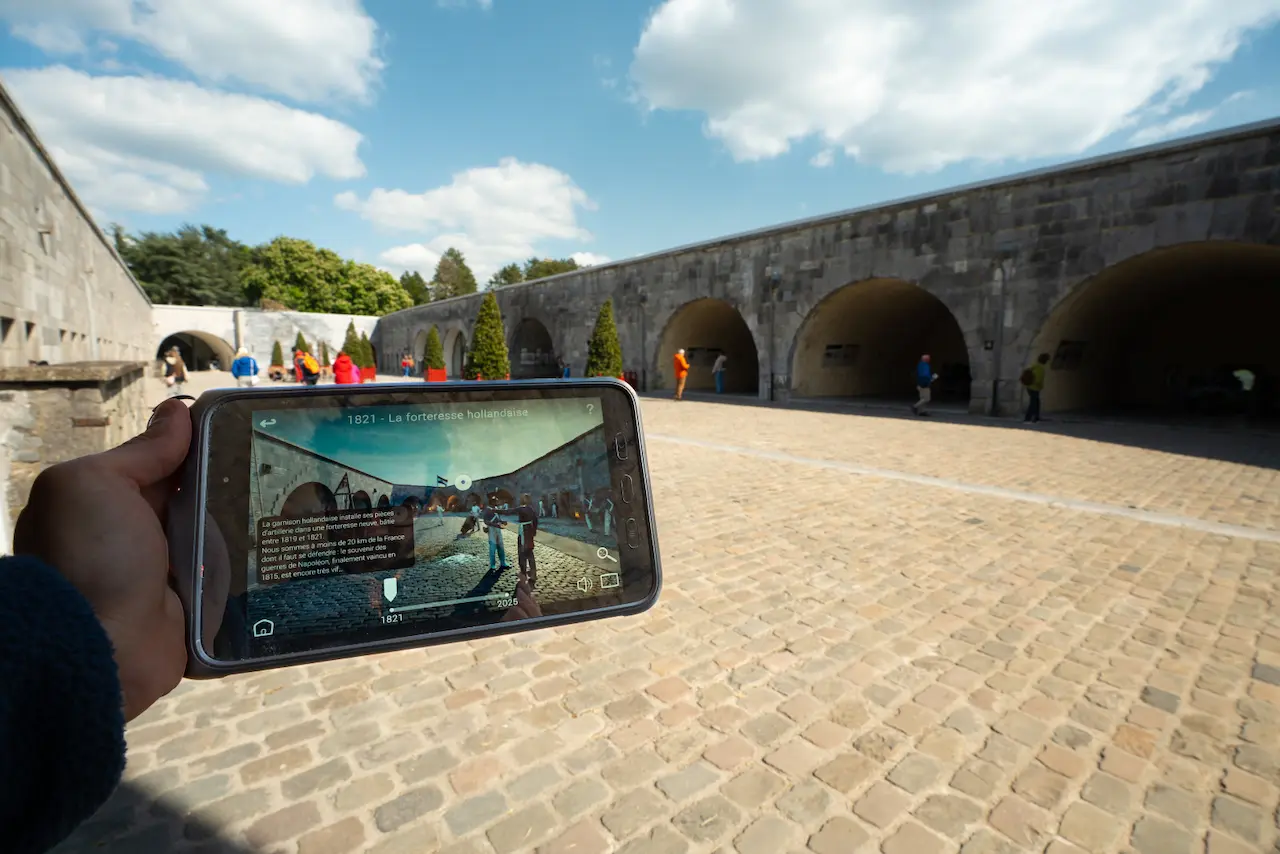
Developed by Histovery, a global pioneer in heritage technology, the HistoPad uses the Unreal Engine 5 graphics engine (video game industry standard) to calculate photorealistic 3D images in real-time. Provided to each visitor, it geolocates the tablet on the site and reconstructs lost military and residential spaces right before your eyes.
Geolocated 3D reconstruction
Point the tablet: abolished spaces reappear in photorealism on the very site of the events. Certified by scientific committees.
Virtual treasure hunt
For children: searching for hidden 3D historical objects in the scenes. Gamification of learning.
Selfies in historical costumes
Augmented photography allowing you to immortalize yourself in period costumes (Burgundian knight, Napoleonic soldier...) shareable on networks.
Adult & expert modules
Poliorcetic architecture (Italian layout, scarps), military geopolitics, biographies. Adaptable pace and complexity.
Recommended visit duration: 1h30 with HistoPad · 1h in condensed circuit · Included in ticket from €15 (adult)
🕯️ August 15–23, 1914 · 2nd Sack of Dinant
On August 15, 1914, the German 3rd Army (General von Hausen, Schlieffen Plan) seized the citadel. Lieutenant Charles de Gaulle was wounded in the leg on the Dinant bridge that same day — his baptism of fire. On August 23, Saxon troops massacred 674 civilians by firing squad and burned over 1,000 homes (~80% of the urban fabric).
Reconstruction of an air-raid shelter torn apart by bombings, tilted at 35° to the horizontal. Visitors walk through this dark, confined, and slanted environment. The loss of spatial references, vestibular imbalance, and vertigo are intentionally provoked to viscerally make you feel the profound anguish and claustrophobia of fighters under shellfire.
The future General de Gaulle, then a young lieutenant in the French 33rd Infantry Regiment, received his baptism of fire on August 15, 1914, during the fighting for control of the Dinant bridge. Wounded in the leg on the bridge deck itself, this episode enshrines the Citadel in French military mythology.
🎟️ 2026/2026 Prices · Open 365 days/year
All rates include the entrance ticket + the augmented reality HistoPad. The 3-in-1 Package adds the guided cruise on the Meuse with Dinant Évasion.
Adult individual
10 AM–6 PM / 10 AM–4:30 PM
€15
Citadel Access (cable car or 408 steps) + UE5 HistoPad
Child (4–12 yrs)
10 AM–6 PM / 10 AM–4:30 PM
€13
Access + HistoPad + Virtual treasure hunt
Group adult
min. 20 pers.
€11
Preferential group rate + HistoPad included
3-in-1 Package
Adult individual
€25
Citadel + HistoPad + Guided Meuse cruise (Dinant Évasion to Anseremme)
3-in-1 Package
Child individual
€20
Citadel + HistoPad + Meuse cruise · Child rate
3-in-1 Package
Group adult
€22
Citadel + HistoPad + Meuse cruise · Group 20+ pers.
Choose price & book
Individual or group (min. 20)? The 3-in-1 Package (€25) is recommended: it integrates the Meuse cruise to admire the citadel from the river.
Access the top
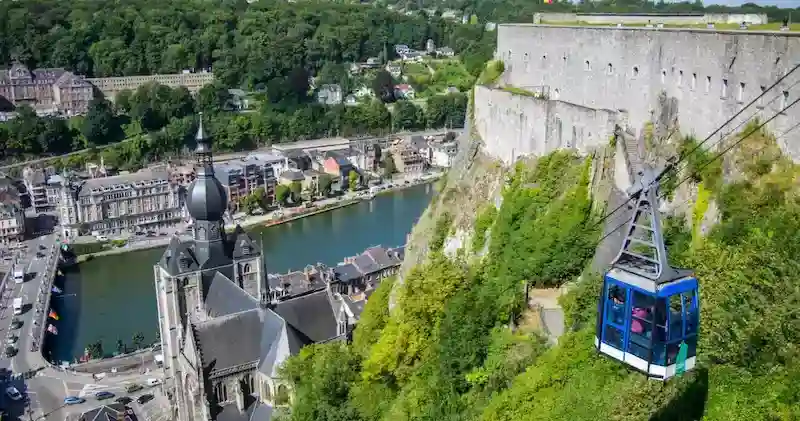
Cable car (panoramic, PRM, families) or 408 historical steps carved in the rock. Both included in the ticket.
Get the HistoPad
Geolocated UE5 tablet. Choose adult mode (architecture & geopolitics) or child (treasure hunt). Point at walls to see reconstructed spaces.
Explore Bergsma bastions
~1h30 route: inner courtyards, casemates, south-east bastions, Madame de Maintenon's carriage, 1840 drilled well, panoramic viewpoints.
The 1914 Space – collapsed shelter
35° sensory experience: loss of reference points, vertigo, period sounds. The most striking part of the site for adults.
Meuse Cruise (3-in-1 Package)
Join Dinant Évasion by the river for the guided cruise to Anseremme and the view from the water of the illuminated citadel.
Rue Adolphe Sax 3, 5500 Dinant. Parking in the lower town. The cable car leaves from the foot of the cliff (next to the Collegiate Church of Notre-Dame). Open 365 days/year: high season 10 AM–6 PM · low season 10 AM–4:30 PM.
🏢 Business tourism · MICE · Incentive
The exceptional setting of the fortress perched on its rocky spur offers an exclusive and highly inspiring environment for corporate seminars, incentives, and conferences.
3 modular meeting rooms (banquet, theater or cocktail format). The largest: up to 300 people. Full equipment: secure high-speed WiFi, latest-generation video projectors, built-in screens, certified reduced mobility access.
Internal restaurant for gala banquets. Free choice caterer also possible (from walking dinner to seated gourmet dinner). Nearby partner brands: Taverne de la Meuse, Le Jardin de Fiorine, Chez Nino.
High-end workshops led by recognized experts (sommelier Eric Boschman). Discovery of Walloon terroir beers and wines. Distinctive and memorable team-building activities.
Dinant Évasion fleet: ships from 6 to 50 people. Prestigious night cruises, privatized gastronomic routes, musical river evenings under the illuminated citadel.
Frequently asked questions
The first documentary mention dates back to 1040. Its construction was driven by Bishop Nithard of the Principality of Liège, completed around 1080. Initial objective: to control the bridge over the Meuse and protect the brassware industry (dinanderie), which had commercial privileges in London as early as the 13th–14th centuries.
2026/2026 prices (include entrance ticket + HistoPad in augmented reality): Individual adult = €15; Child (4-12 years) = €13; Group (min. 20 people) adult = €11. 3-in-1 Combined Package (Citadel + HistoPad + Meuse Cruise with Dinant Évasion): individual adult = €25, individual child = €20, group adult = €22, group child = €16.
Open 365 days a year. High season (April–Sept.): 10 AM–6 PM. Low season (Oct.–March): 10 AM–4:30 PM. Recommended visit duration: 1h30 (condensed circuit: 1h).
Two access routes included in the ticket: (1) Panoramic cable car (ideal for PRMs and families); (2) 408 steps carved into the limestone rock in 1577, connecting the Collegiate Church of Notre-Dame to the south posterns. Cable car duration: 1 min. Stairs duration: 15-20 min.
The HistoPad is an augmented reality tablet (Unreal Engine 5 engine, developed by Histovery) provided to each visitor. It reconstructs lost spaces in 3D right on the site. Features: virtual treasure hunt, selfies in historical costumes, adult modules on poliorcetic architecture. Duration: 1h30.
The Sack of Dinant (August 17-29, 1466) is the most traumatic event in its medieval history. Following a public insult to the future Charles the Bold, a Burgundian army of about 30,000 men besieged Dinant. The town capitulated on August 25, followed by 2 days of pillaging, executions of civilians (thrown into the Meuse) and total burning. The fortress was razed and the brassware industry destroyed.
In September 1830, Dinant and Ciney volunteers blockaded the citadel held by Major de Venne's Dutch garrison. Unable to be resupplied with water due to the broken rope system, the garrison capitulated on October 2, two days before the declaration of Belgian independence.
Yes. On August 15, 1914, during the Battle of Dinant, Lieutenant Charles de Gaulle (33rd Infantry Regiment) received his baptism of fire during the fighting for the Meuse bridge. He was wounded in the leg on the deck of the bridge itself. On August 23, German troops massacred 674 civilians and burned 1,000+ homes (~80% of urban fabric), commemorated at the 1914 Space.
The current citadel was designed by the Dutch captain-engineer Eiso Bergsma (1818-1821) as part of the Wellington Barrier – a post-Napoleonic program funded by the UK to protect the Netherlands from a French resurgence. Polygonal plan in an asymmetrical horseshoe pentagon, capacity for 400 soldiers. Above the entrance gate, a Latin engraving recalls: "6th year after the battle of Waterloo".
🏰
Open 365 days/year. From €15 adult (HistoPad included). 3-in-1 Package (+ Meuse cruise) from €25. Groups and MICE upon reservation.
Rated 4.6/5 based on 1,282 reviews
« A perfect family day on the Semois. The welcome at Kayak Semois Ardenne is warm, the equipment is spotless (the kayaks are modern and clean), and the free shuttle system is superbly organised. A must-visit in the Ardennes! »
« Beautiful kayak trip on the Semois starting from Vresse! Very friendly staff and excellent shuttle service. The riverside campsites along the Semois are also a must for nature lovers. »
« Superb 11 km kayak descent starting from Alle-sur-Semois. The wild nature of the Ardennes is magnificent in the spring sunshine. Very competitive prices compared to the competition. We'll be back! »
« Wonderful experience! The kayak tour on the Semois was perfectly organised. The team is very helpful and speaks good German. The scenery of the Belgian Ardennes is simply breathtaking. »
« Excellent kayak rental service and great campsite on the banks of the Semois. The prices are very fair and the atmosphere is friendly and family-oriented. The little terrace bar is perfect for a refreshing drink after the effort. »
« A fantastic last-minute welcome even though we hadn't booked in the middle of August. Life jackets and waterproof barrels are provided free of charge. Very safe descents, ideal with children! »
« Top-tier kayak rental on the Semois river. Extremely friendly staff, well-maintained kayaks, and a reliable shuttle. The viewpoints along the river are absolutely stunning. Highly recommend this local business! »