★★★★★
Very good, cheap and very friendly welcome. Thank you, because for my first time kayaking, I love it. I recommend it. See you next time 👍🙂
Where untouched nature meets the art of living: discover the transformation of an exceptional territory at the heart of the Semois valley — 28,980 hectares of ancient forests and wild rivers.
↓ Explore
The Semois valley is not just another destination. It is a territory undergoing profound change, one that has successfully transformed its natural assets into a unique identity — that of an Ardenne that is simultaneously wild and glamorous, reconciling ecological rigour with the demands of high-end tourism. Since the official creation of the National Park in 2022, this corner of Belgium has reinvented itself without betraying its soul, preserving its centuries-old beech forests and trout rivers while welcoming unusual accommodation, gourmet dining experiences in the forest and wellness practices inspired by Japan.
This comprehensive guide takes you into the heart of this fascinating duality: the otter gliding silently across the Semois at dawn, the lynx tracked by artificial intelligence cameras in the southern massifs, the black stork nesting in the park's absolute quiet zones. But also the transparent bubbles of L'Étape Insolite, gourmet dinners featuring wild herbs, and forest baths that reduce cortisol in two hours. The 21st-century Ardenne is both pristine and sophisticated — which is precisely why it is irresistible.
Officially established in late 2022, the Semois Valley National Park forms the foundation of a new territorial identity. This status imposes an ambitious long-term vision: protect biodiversity while developing high-quality sustainable tourism that celebrates every kilometre of river and every hectare of forest.
The Semois Valley National Park unites 8 Ardenne municipalities: Arlon, Tintigny, Florenville, Herbeumont, Bouillon, Paliseul, Bertrix and Vresse-sur-Semois. Shared with the Entre-Sambre-et-Meuse park, it covers 28,980 hectares whose defining characteristic is exceptional forest density — between 75 and 86% of the surface area, depending on the section. This forest is no longer merely a timber resource. It is now a "nature capital" valued for its multiple ecosystem services: local climate regulation, water filtration, carbon storage, and of course, immersive tourism potential.
The 2023–2026 management plan articulates several priority axes. On the biodiversity front, it provides for the restoration of wetlands, the creation of ecological corridors between fragmented forest massifs, and a programme for the reintroduction and monitoring of iconic species. On the sustainable tourism side, it defines strict zoning: absolute quiet zones where human access is regulated (refuges for the black stork and lynx), developed visitor zones with marked trails and light infrastructure, and buffer development zones where glamping and premium ecotourism are actively encouraged.
A network of naturalist ambassador guides has been trained to accompany visitors: these nature interpreters master ornithology, local botany, mammal tracking and landscape-reading techniques. Their presence transforms a forest walk into an unforgettable educational and emotional experience. The park is also developing digital tools: a citizen science app allows hikers to report species observations, feeding a real-time database used by scientists at ULB and Gembloux Agro-Bio Tech.
The first large-scale Walloon national park, it succeeds decades of partial designations and scattered protected natural areas. It unifies governance and strengthens the territory's international appeal.
Ardenne forest sequesters an average of 4.5 tonnes of CO₂ per hectare per year. It supplies drinking water to 200,000 people. This quantified ecosystem value strengthens the case for its absolute protection.
A multi-year plan harmonises human presence with ecological requirements, from targeted felling of senescent trees to the training of ambassador guides, including unified signage across all 8 municipalities.
The forest, covering between 75% and 86% of the total surface area, is no longer merely a timber resource, but becomes a "nature capital" valued for its ecosystem services and its immersion potential. The National Park status gives this territory the international visibility it deserves.
— Management Plan 2023–2026, Semois Valley National ParkIn the vocabulary of the modern Ardenne, "wild" is synonymous with exclusivity. The otter, the lynx and the black stork are not merely subjects of scientific study — they are symbols of an intact nature that justifies a premium positioning and attracts visitors from around the world.
The European otter (Lutra lutra) is the ambassador par excellence of the restored Semois. After decades of absence due to water pollution and poaching, it returned naturally to the riverbanks as soon as water quality improved. Today, several otter families occupy territories of 10 to 20 km along the river. Their scent latrines — small mounds of droppings deposited on exposed rocks — betray their presence to those who know what to look for. To observe them, you must rise before dawn, glide silently by kayak and watch the calm stretches between the meanders. The chances are real, especially between November and March when the riverside vegetation is less dense.
The Eurasian lynx (Lynx lynx) is the great enigma of the Ardenne. Its presence is confirmed by camera traps and environmental DNA analysis, but spotting one is almost miraculous: this feline of around 25 kg requires 100 km² of territory and is only active at night. In 2024, an artificial intelligence programme was deployed, cross-referencing data from 80 automatic cameras with fur-recognition algorithms. The results point to a small population — perhaps 3 to 5 individuals — in the most remote massifs of southern Ardenne. Their mere existence justifies the creation of transboundary ecological corridors with Luxembourg and France.
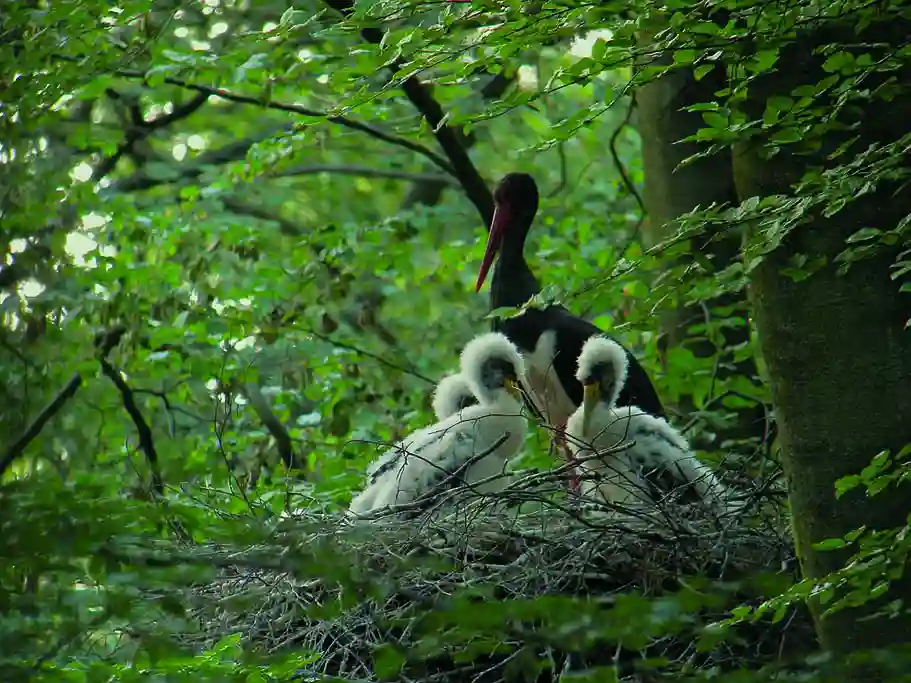
The black stork (Ciconia nigra) is the most discreet of the valley's large species. Unlike its white cousin that nests on church towers, it prefers old deciduous forests far from any human presence. It builds its large nest in ancient beeches or century-old oaks, within absolute quiet zones delimited by the park. Spring and summer see it follow watercourses in search of fish and amphibians. Its sighting is rare but unforgettable: a black silhouette with metallic green and purple reflections, with a bright red bill and legs — a jewel of the avian world.
| Species | Status | Best period | Habitat & Observation |
|---|---|---|---|
| 🦦 European Otter Lutra lutra |
Strictly protected | Nov–Mar · Dawn/dusk | Semois riverbanks — Vresse, Bouillon |
| 🐆 Eurasian Lynx Lynx lynx |
AI monitoring / camera traps | Autumn · Nocturnal | Dense massifs of southern Ardenne |
| 🐦 Common Kingfisher Alcedo atthis |
Water quality indicator | Year-round | Meanders and muddy riverbanks |
| 🦅 Peregrine Falcon Falco peregrinus |
Nests on sandstone cliffs | Feb–Jul · Daytime | Steep slopes overlooking the river |
| 🦢 Black Stork Ciconia nigra |
Discreet forest species | Apr–Aug · Morning | Absolute quiet zones of the park |
| 🦫 Eurasian Beaver Castor fiber |
Successfully reintroduced | Year-round · Dusk | Riverbanks and restored wetlands |
Luxury no longer lies in material opulence, but in the quality of the view, the surrounding silence and organic design. Welcome to the era of Ardenne glamping, where contemporary comfort blends seamlessly into the most authentic forest setting in Belgium.
The concept of the "glamour forest" was born of a simple observation: the most discerning travellers now seek to sleep in nature — not in spite of discomfort, but thanks to comfort. They want to hear the eagle owl from their bed, to see the morning mist envelop the meanders from their terrace, to smell spruce resin through their half-open window. What the Ardenne offers uniquely is the sensory intensity of an unspoilt natural environment, coupled with hotel infrastructure that sacrifices nothing to well-being: linen sheets, gourmet dinners with local herbs, wood-heated Nordic baths under the stars.
This movement generates a virtuous local economy: glamping operators source locally (Orval beer, Gaume cheeses, park game), employ naturalist guides for activities, and contribute financially to conservation through earmarked tourism taxes. The visitor who pays €350 per night in a transparent bubble is indirectly funding the restoration of wetlands 5 km away. It is a model of regenerative tourism that is beginning to set an example at the European level.
The Semois valley is not merely a backdrop — it is something to be savoured. Local gastronomy is undergoing a fascinating renaissance through the promotion of foraged produce, the excellence of local terroirs and a new generation of chefs who cook the landscape.
Ardenne gastronomy along the Semois is undergoing a revolution. Long associated with charcuterie, Ardenne ham and Trappist beer, it is now enriched by a wild and plant-based cuisine inspired by the international "forest-to-table" movement. Chefs such as those at Le Moulin Hideux (Noirefontaine, 2 Michelin stars) or La Grappe d'Or in Bouillon work with spruce shoots at the start of the season, elderflower in June, ceps and chanterelles in autumn, and Gaume truffles in winter. The menu changes to the rhythm of the undergrowth.
Orval Abbey remains the absolute gastronomic icon of the region. Its Trappist beer, brewed by Cistercian monks since 1931, is considered one of the most complex in the world: bottle-conditioned, it develops aromas of honey, citrus and spices that evolve over time. Orval cheese, aged in a damp cellar, completes this perfect pairing. A visit to the abbey — accessible by car from Florenville — now includes guided tastings and an exhibition on Cistercian history.
The Tobacco Route, inscribed on Wallonia's intangible heritage list in 2025, traces an agricultural tradition unique to Belgium: tobacco cultivation in the Gaume region and along the Semois. The wooden clapboard drying barns at Laforêt and Alle-sur-Semois are the architectural witnesses of an era when leaves dried slowly in ventilated buildings bathed in filtered light. Today, a handful of artisan producers perpetuate this tradition, transforming tobacco into niche products and authentic tourist experiences.
Bottle-conditioned Trappist beer and cave-aged cheese. Visit to the ruins and active brewery, guided tasting. Global renown since the Cistercian monks.
Workshops with local chefs: open-fire cooking, wild herbs gathered that morning, spruce infusion, flambéed with artisan Gaume gin. A complete sensory experience.
Walloon intangible heritage since 2025. The century-old wooden drying barns at Laforêt and Alle-sur-Semois, artisan producers and museums trace 4 centuries of Gaume tobacco culture.
Han Hall (Tintigny) and seasonal markets in Florenville, Bouillon and Vresse. Local artisans, cheesemakers, charcutiers, brewers and beekeepers in ultra-short supply chains, with on-site tasting.
The Ardenne is establishing itself as a destination for mental health and psycho-physical regeneration. Forest bathing (Shinrin-yoku), imported from Japan via Scandinavia, finds an ideal setting in the Ardenne massifs — ancient beech forests whose forest microclimates are particularly rich in beneficial phytoncides.
Forest therapy is founded on robust science. Studies conducted in Japan, South Korea and more recently in Central Europe show that two hours of exposure in dense forest reduces salivary cortisol by 12 to 15%, lowers systolic blood pressure by 4 to 7 mmHg, and significantly increases the activity of NK (Natural Killer) cells in the immune system. The biological mechanisms involve phytoncides — volatile organic compounds emitted by trees (monoterpenes, sesquiterpenes) with anti-inflammatory and antiviral properties demonstrated in vitro.
In the Ardenne, the acidophilous beech forests that dominate the north-facing slopes and plateaus offer a particularly dense cocktail of phytoncides in late spring and autumn. The spruces of production plantations are rich in alpha-pinene and limonene — compounds with well-documented anxiolytic effects. Therapists certified by the European Forest Therapy Association offer guided sessions of 2 to 4 hours in zones specifically mapped for their phytoncide richness and minimal noise levels (below 35 dB).
Beyond forest therapy in the strict sense, the Ardenne is developing a holistic wellbeing offer in natural surroundings: sunrise yoga in a forest clearing, 3-day Vipassana meditation retreats in forest refuges, sensory reconnection workshops for children, and post-burnout recovery programmes supervised by psychotherapists. The European "Horizont Climatic" project (2024–2028), coordinated from Bouillon, creates proprioception trails and therapeutic gardens accessible to people with disabilities — a rare inclusivity in this sector.
Sessions of 2 to 4 hours with a certified therapist. Slow mindful walking, deep breathing exercises, sensory contact with bark, humus and the canopy. Cortisol measured before and after.
In Tenneville, Bouillon and the Saint-Michel forest: 2 to 5-day stays focused on psychological recovery, mindfulness and reconnection with nature. Supervised by mental health professionals.
"Horizont Climatic" project (2024–2028): proprioception trails on varied surfaces, sensory therapeutic gardens and wheelchair-adapted paths at 4 park sites. Therapeutic forest for everyone.
The repositioning towards "wild glamour" does not sacrifice physical activity — it transforms it into an aesthetic and immersive experience. Every meander of the Semois reveals a new tableau; every elevated path offers a breathtaking perspective.
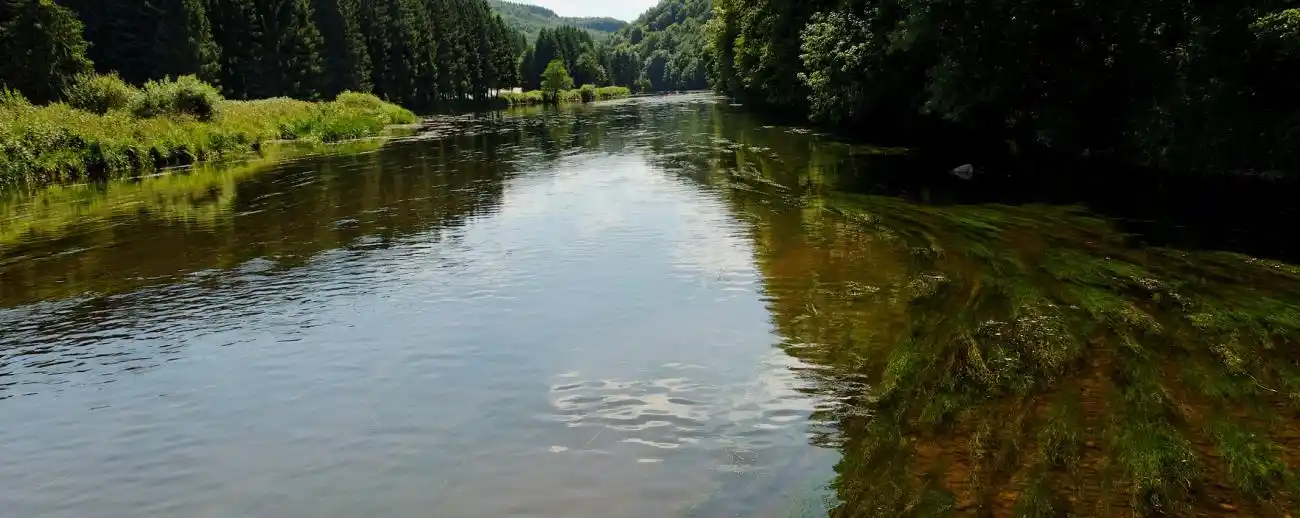
Kayaking and canoeing remain the signature activities of the Semois. The river winds 210 km of meanders between its source and its confluence with the Meuse, offering sections for all levels. The classic stretch Alle-sur-Semois–Bohan (22 km, 1 to 2 days) is considered one of the most beautiful in North-West Europe: the panoramas from the "Korea" and "Tombeau du Géant" meanders were awarded by Nature Travel Europe magazine in 2023. Approaching Bouillon, the river narrows between schist cliffs where peregrine falcons nest — an experience that transcends sport to become a sensory journey.
Packrafting is the great emerging trend of recent years. This sport combines hiking with navigation on an ultra-light inflatable mini-raft (1.5 to 2.5 kg), carried in a backpack and inflated at the water's edge. The freedom is total: you can alternate forest walking and paddling, explore secondary channels inaccessible to conventional kayaks, and bivouac on gravel islands. The Semois, with its relatively calm waters and wild banks, is an ideal playground. In autumn, when the forest blazes and morning mist skims the river, the experience reaches an almost mystical dimension.
210 km of listed meanders. Iconic sections: Alle–Bohan (22 km, easy level), the Ardenne Korea and the Tombeau du Géant. View of Bouillon castle from the water. Spot otters, kingfishers and grey herons along the way.
Hiking + light paddling: complete self-sufficiency. 1.5 kg mini-raft in your pack, gravel bivouac, secondary channels unreachable by kayak. Introductory sessions available with local operators. Particularly prized in autumn amid blazing colours.
The GR 16 "Sentier de la Semois" (200 km) is considered one of Belgium's finest long-distance trails. Specialist trail stations attract demanding sports enthusiasts: Herbeumont, Vresse and Bouillon offer technical marked loops for mountain biking and trail running.
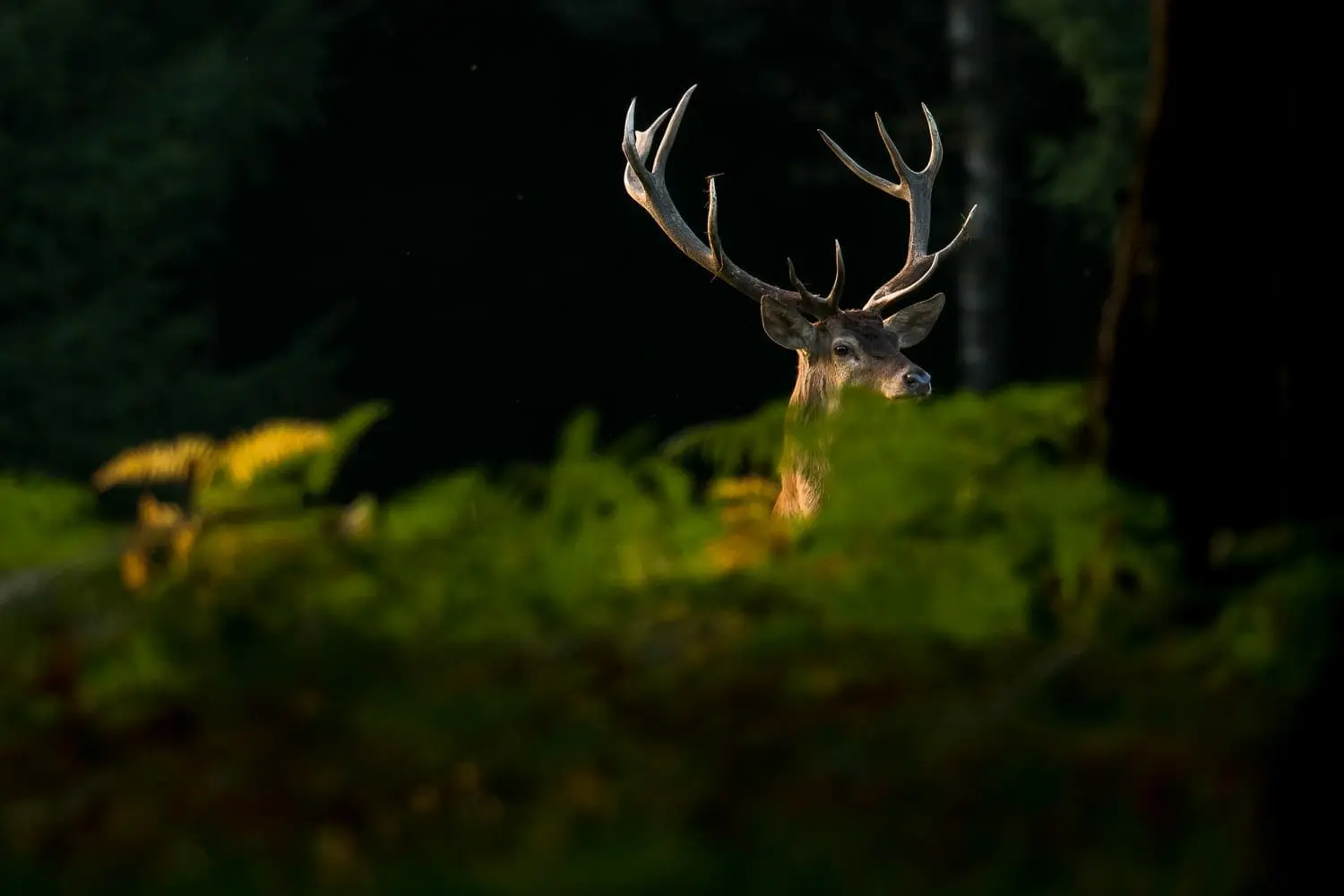
Specialist hides at dusk and dawn: badger observation hides with discreet viewing platforms, red deer rutting observation points (Sept–Oct), listening posts for nocturnal raptors (tawny owl, barn owl). Naturalist guides organise these outings by reservation.
The Semois valley is classified as a Special Protection Area (SPA) for birds. 180 species nest in the park, including 14 of European importance. Guided birdwatching outings in spring, introduction to birdsong, contribution to the Wallonia breeding bird atlas via the Observations.be app.
The schist sandstone cliffs overlooking the Semois offer natural climbing routes for all levels. Canyoning (descending steep streams with abseils, natural slides and jumps into pools) is possible in the left-bank tributaries — an intense sporting alternative to kayaking.
The vocabulary of the wild Ardenne encompasses an essential human and historical dimension. The slate-stone villages and fortified castles tell centuries of resilience, commerce and art de vivre — a narrative layer that enriches every excursion with historical depth.
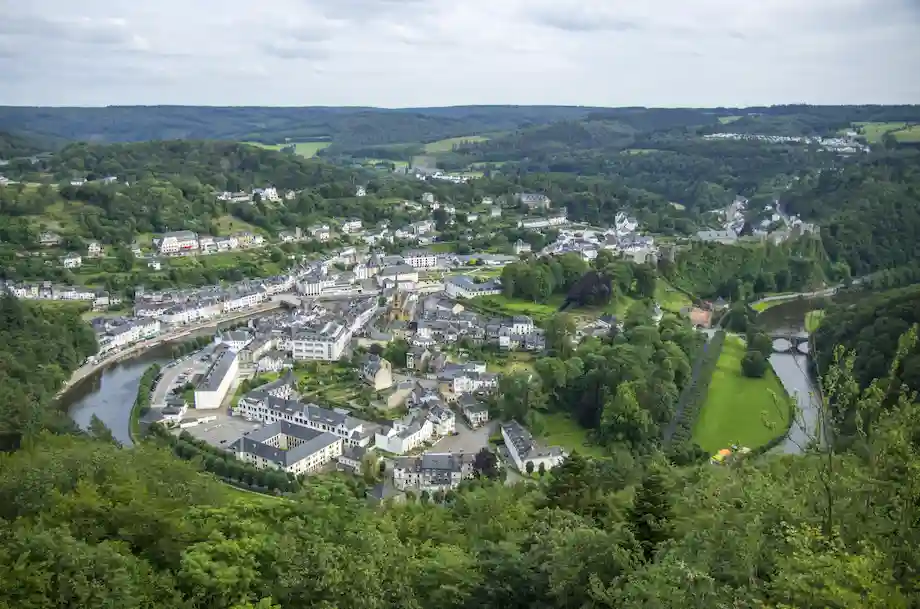
These villages form a 120 km cultural itinerary linking Orval in the north to Vresse in the north-west, passing through the schist hamlets of the valley. A signposted driving route, the "Route des Villages de la Semois", links them over 2 days with programmed gastronomic and heritage stops. Most villages have charming gîtes, allowing total immersion far from mass tourism. It is here that one understands why this valley inspired the Expressionist painter Constant Permeke and the writer Maurice Genevoix — an austere and profound beauty, that of landscapes which only reveal themselves to those who take the time.
The appeal of the Semois valley rests on a chromatic and sensory variation of exceptional richness. Each season reinvents the territory — the same setting, but with radically different light, sounds, smells and atmosphere. It is this versatility that keeps visitors coming back year after year.
Carpets of golden daffodils in the undergrowth, explosive flowering of water buttercups on the Semois, first black storks returning from Africa. The season of singing birds and fresh herbs. Ideal for birdwatching and guided botanical outings. Water levels favour sporting kayaking on faster sections.
Water pleasures, kayaking and packrafting along the turquoise water. Gaume Jazz Festival in Rossignol, International Street Arts Festival in Chassepierre, crossing the Pont de Claies. The Semois reveals its gravel beaches as water levels drop. The season for families and aquatic adventurers — outdoor living from June to September.
Unquestionably the most glamorous season. Gradients of red, gold and purple blazing across the schist slopes. Red deer rutting at dawn in silent clearings. Game and mushroom gastronomy. Packrafting through the morning mist rising from the river. The colours of the Semois in autumn are among the most photographed natural spectacles in Belgium.
Authentic Christmas markets in slate-stone villages, evenings by the fireside in charming gîtes, Nordic baths under the stars at candlelit glamping sites. In severe frost, the rare phenomenon of ice forming "from the bottom up" in the Semois (ice crystals rising from the riverbed) creates hypnotically beautiful scenes.
The Semois valley is easily accessible from the major Belgian cities and neighbouring countries. Here is everything you need to know to plan your stay in the best conditions.
From Brussels: SNCB train to Libramont (1h30), then TEC to Bouillon (45 min), Herbeumont or Vresse. From Luxembourg city: train to Arlon (20 min), bus to Tintigny and Florenville. In high season, direct seasonal TEC lines serve the valley villages.
From Brussels: E411 towards Luxembourg, exit Recogne (N89) or Libramont. Allow 1h45. From Paris: A4 to Stenay, then N43 towards Florenville (3h). From Amsterdam: A2, E25, E411 — approximately 3h30. Free parking in most villages.
The Semois Valley Cycling Route (RAVeL) follows the river for 50 km between Florenville and Bohan. It is integrated into EuroVelo 3 — the "Pilgrims Route" linking Trondheim to Seville. Electric bikes are available for hire in the main park villages.
Semois National Park app: offline mapping, observable species, marked trails. Observations.be for citizen science. The Semois water level live feed on our site. The park welcome centre is based in Florenville (rue du Parc, 1).
Paddle the Semois by kayak, sleep under the stars in a transparent bubble, savour Orval beer facing ancient meanders — and leave changed.
Very good, cheap and very friendly welcome. Thank you, because for my first time kayaking, I love it. I recommend it. See you next time 👍🙂
Contrary to other published opinions, we were very well received, the team is very friendly and the kayak rental is cheaper here than elsewhere. We recommend Kayak Ardenne!
Fantastic campsite, affordable prices and adorable staff!
Top, very friendly and good service. Correct prices.
We stayed 1 night in a tent and did the 11km kayak descent. Helpful and super friendly staff. Perfect organization for arrival on the Semois and reception after the descent. Thanks for everything!
We were able to enjoy this day thanks to the lady at the kayak bar! Without knowing it, we hadn't booked. She found a last minute solution! Top thanks again!
Excellent kayak rental on the Semois. Different routes possible for short or long distance depending on the wish. The staff is very friendly and advises you perfectly!
Magnificent canoe descent (17km), the service is very good, we wait little even at arrival thanks to the driver and his wife. In addition, the small cafe with terrace is very pleasant.