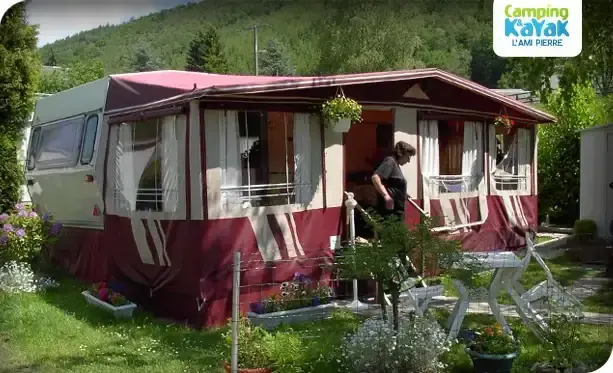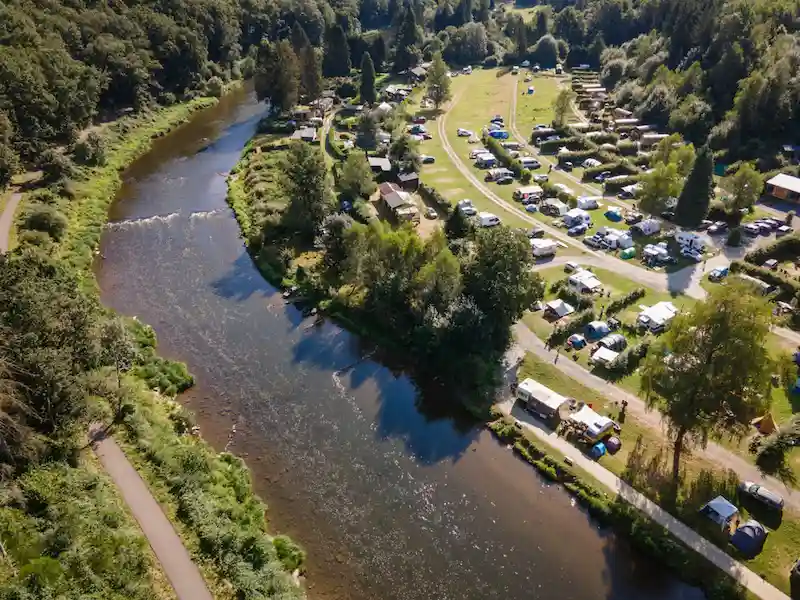
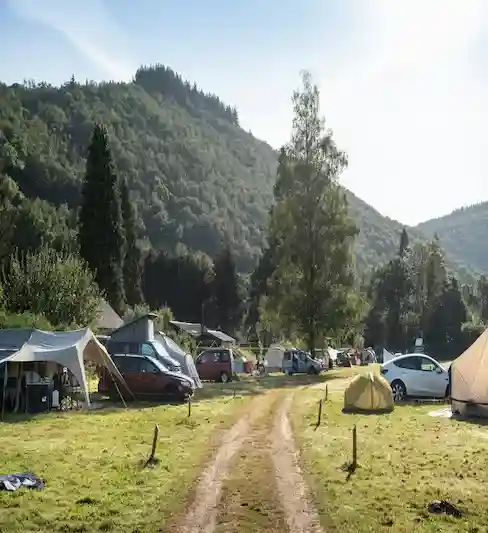
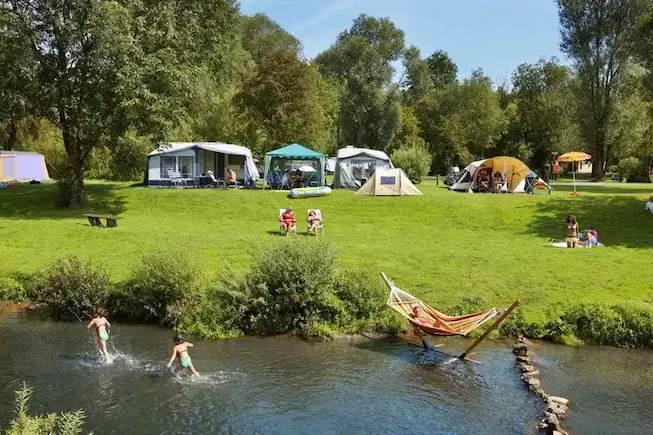
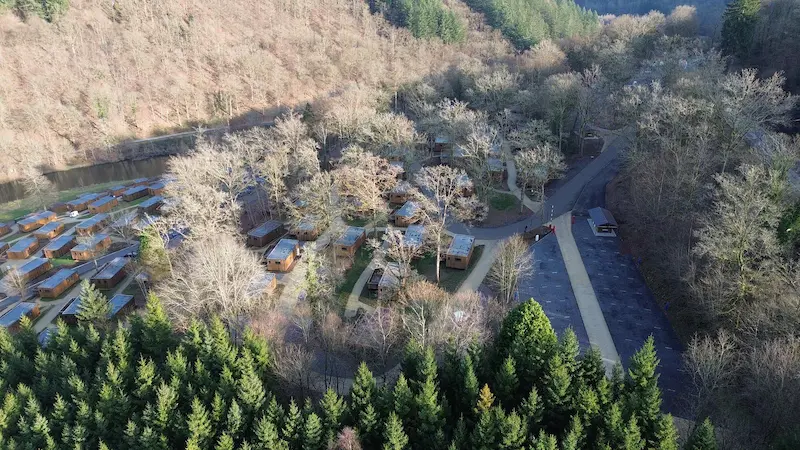
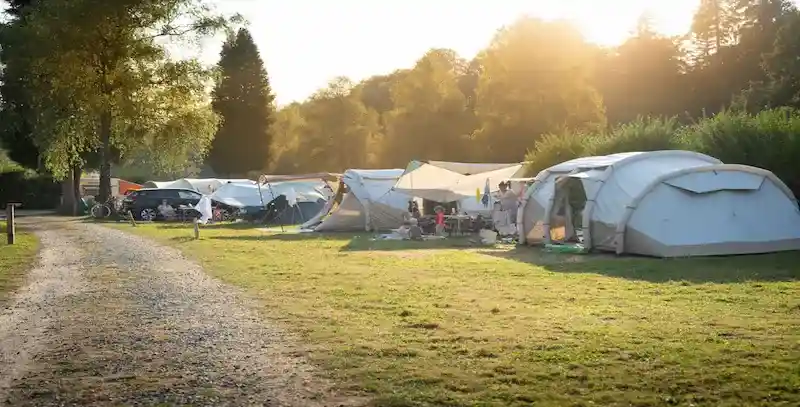
Rue du Moulin 15, 5550 Mouzaive | €€ · 13 ha · 180 pitches
Huttopia Semois
180 pitches. Gypsy caravans, Trapper tents (wood stove), Portland Chalet 3 bedrooms. Swimming pools. Targeting large families and groups.
From the Walloon Code 2025 schedule to the 86 campsites in the red flood zone, from the EH sizing of IDELUX septic tanks to the 2035 off-grid scenarios: a technical and prospective radiography of outdoor hospitality in the Semois Valley.
Sustainable tourism transition laboratory
The Semois Valley is undergoing an unprecedented structural mutation in its outdoor hospitality industry. Between the emergence of the National Park (2022), the new Walloon Tourism Code (July 2025), the restrictions on flood zones post-2021, and the rise of glamping — operators must simultaneously navigate unprecedented legal, climatic and economic imperatives.
The Valley represents a unique study territory because it concentrates all the dynamics at work in Walloon outdoor tourism: 38% of Ardennes accommodations belong to the outdoor segment. A tourist spends an average of €117 per day in Wallonia. And the Dutch clientele — 35.9% of camping overnight stays — represents the main engine of growth.
"The professionalization imposed by the new Tourism Code, coupled with the ecological requirement of the National Park, draws the outlines of an atmospheric hospitality of excellence capable of combining economic prosperity and environmental robustness."
| Origin | % camping nights | Avg duration | Preferences |
|---|---|---|---|
| 🇧🇪 Belgians | 9.0 % | 3.1 nights | Relaxation, bike rides |
| 🇳🇱 Dutch | 35.9 % | 4.0 nights | Nature, hiking, equipped camping |
| 🇩🇪 Germans | 14.6 % | 3.1 nights | Natural sites, gastronomy |
| 🇫🇷 French | 7.7 % | 3.5 nights | Built heritage, gastronomy |
| 🇬🇧 English | 8.9 % | 4.3 nights | Well-being, bike hiking |
Source: Wallonia Tourism · Ardennes Tourism Report 2024
Almost doubling of foreign overnight stays on the equipped segment
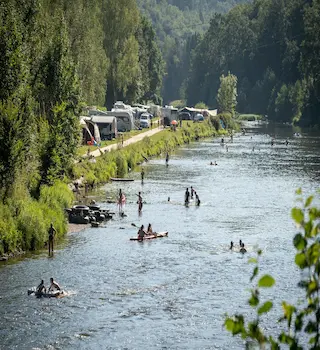
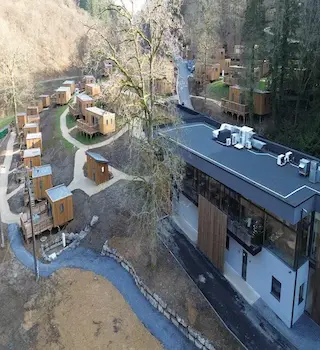
Visual documentation
⚖️ New Walloon Tourism Code · In force July 1, 2025
July 1, 2025 launches a regulatory counter whose critical milestones structure all future investments. No unregistered accommodation can legally operate after January 1, 2026.
July 1, 2025
Replacement of name authorization with a certification system. Redesign of categories: Tourism Furnished, Guest House, Unusual Accommodation.
January 1, 2026
Any accommodation must be registered with the General Commissariat for Tourism BEFORE this date. After: illegal operation. Required documents: ASI, ACS, conformity certificate, criminal record model 596.1.
Since 2023
Required for any fixed installation or modification of topography in sensitive zones. Critical articulation with PGRI restrictions for Semois riverside campsites.
July 1, 2030
Mandatory to use protected names and access regional subsidies (reviewable every 3 years for campsites and holiday villages). CBE number required.
| Device | Deadline | Impact | Status |
|---|---|---|---|
| Walloon Tourism Code | Jul 1, 2025 | Category redesign | ✅ Active |
| CGT Registration | Jan 1, 2026 | Operation legality | ⚠️ Urgent |
| Certification | Jul 1, 2030 | Names + subsidies | 📅 Plan |
| CoDT Planning Permit | Since 2023 | Fixed installations | ✅ In force |
| Flood Zones | Dec 31, 2024 → 2026 | Resid. caravans | ⚠️ In progress |
Key players inventory
From the 110-lodge ecovillage to the island campsite in Bertrix, the Valley offers a full spectrum of outdoor accommodation, each positioned on a distinct segment.
Rue du Moulin 15, 5550 Mouzaive | €€ · 13 ha · 180 pitches
180 pitches. Gypsy caravans, Trapper tents (wood stove), Portland Chalet 3 bedrooms. Swimming pools. Targeting large families and groups.
Allee des Soupirs, 6830 Bouillon | €€ · Ecovillage · 110 lodges
Floreal holiday village. 110 sustainable lodges + automated motorhome area. Integrated local brewery. Regenerative ecovillage model.
Rue du Miroir 1, 6820 Florenville | €€ · 30m pool · Freecamp
30m heated pool at 27°C. Freecamp pitches with private mini sanitary block on plot. 3–4 star standard.
Rue de la Semois 30, 5550 Alle-sur-Semois | € · 55 pitches · Year-round
Open year-round. Electric MTB rental. Advanced de-seasonality strategy. "Bienvenue Vélo" label compatible.
Mortehan 48, 6880 Bertrix | € · Insular campsite · Nature
Exceptional location on an island in the river. Recently renovated sanitary facilities. Unique island configuration in the Ardennes. Peace and total immersion.
⚠️ Major risk · PGRI 2022-2027
The Semois Valley is characterized by fast-moving floods. Out of 156 Walloon campsites affected by hazard zones, 86 are in the red zone (high hazard). The floods of July 2021 accelerated a reform already underway.
Le Code wallon du Tourisme interdit l'implantation de caravanes résidentielles (fixes) dans les parties inondables des campings en zone d'aléa élevé. Échéance initiale de soumission d'un plan d'évacuation : 31 décembre 2024. Prorogation ministérielle de deux ans possible (jusqu'en 2026) pour les projets de reconversion sérieux. En 2024, seulement 26 établissements comptaient encore des caravanes résidentielles à évacuer sur les 156 concernés.
🔴 ZONE ROUGE
Aléa élevé · Caravanes résid. interdites · Échéance 2024 → prorog. 2026
86 / 156 campings
🟠 ZONE ORANGE
Aléa moyen · Restrictions variables · Obligations d'adaptation progressive
🟢 ZONE VERTE
Aléa faible · Vigilance maintenue · Mesures préventives recommandées
Replace fixed structures with demountable or stilted accommodations. Current construction methods allow for ventilated and drainable crawl spaces that reduce the dam effect during floods. Tiny houses and yurts (light habitat) are particularly suitable thanks to their mobility.
Deployment of river level measurement stations equipped with pressure sensors and GSM modems. Automatic activation of sirens and sending of SMS alerts to vacationers as soon as PGRI thresholds are exceeded. Wallonia supports these investments via the Recovery Plan.
Total prohibition, between November 15 and March 15, to leave road caravans, awnings, wooden terraces or any equipment likely to be carried away by water or to obstruct the flow on site. Obligation to completely clear the plot during the winter risk period.
Map your location in the PGRI
Consult the official flood hazard map on environnement.wallonie.be. Precisely identify which fraction of the campsite is in red, orange or low zone. Official source PGRI 2022-2027.
Inventory residential caravans in red zone
Establish a complete inventory of non-compliant fixed structures. Reminder: in 2024, only 26 concerned Walloon establishments still had some. Check if the December 31, 2024 deadline was met or if an extension was requested.
Submit a serious reconversion plan
To benefit from the extension until 2026, submit a documented reconversion plan to the competent authority with an evacuation schedule and a replacement project with mobile structures.
Adapt remaining structures (stilts, crawl spaces)
Replace eliminated structures with mobile accommodations on stilted ventilated crawl spaces. Simultaneously trigger the CertIBEau procedure for any new hydraulic connection.
Deploy the GSM alert system
Install pressure sensors and GSM modems as soon as possible. Configure the alert protocol (sirens + SMS) with mandatory annual test before the summer season. Request co-financing via the Walloon Recovery Plan.
💧 Water Engineering · Walloon Water Code · IDELUX
Preserving the water quality of the Semois is a sine qua non condition for the sector's survival. The Walloon Water Code imposes strict standards — managed in the provinces of Namur and Luxembourg by IDELUX Eau.
EH is the unit of measurement of the pollutant load for sizing treatment systems. One EH represents:
Crucial for campsites during summer attendance peaks — the load can multiply by 50–100 the nominal annual load over a few weeks.
Water Certification of Built Buildings. Mandatory for any new connection to the public distribution. Guarantees network tightness and strict rainwater / wastewater separation.
In the Ardennes: frequent storm episodes quickly saturate treatment plants if networks are not correctly separated. The whole of Wallonia is a sensitive zone for nitrogen and phosphorus discharges (risk of eutrophication).
| Capacity (EH) | Minimum useful volume / EH | Absolute minimum threshold | Typical campsite application |
|---|---|---|---|
| 5 – 10 EH | 320 liters / EH | 3 m³ | Small campsite < 10 pitches |
| 11 – 20 EH | 215 liters / EH | 3.2 m³ | Family campsite 10–20 pitches |
| 21 – 50 EH | 150 liters / EH | 4.3 m³ | Medium campsite 20–50 pitches |
| 51 EH and + | 120 liters / EH | 7.5 m³ | Large campsite 50+ pitches (Huttopia, Florenville) |
Source: IDELUX Eau · Architects Memento 2021 · Sanitation Plans by Hydrographic Sub-Basin (PASH) · Coordinated Water Code D.01012020
🏕️ Innovation 2019 · Walloon Legal Framework
Since 2019, the Walloon Sustainable Housing Code has offered a specific legal framework for light habitat. Originally designed for alternative residential housing, it now massively feeds the glamping offer in leisure zones.
Light habitat of adapted nomadic tradition. Demountable, circular wood and canvas structure. Perfect landscape integration. Very high demand in Ardennes glamping. Requires a drinking water point and sanitary facilities conforming to habitability standards.
Miniature house on a trailer or light foundations. Reduced volume, low weight, transportable. No upper floor. Can be non-connected. Must satisfy 3 out of 9 criteria according to the Walloon Sustainable Housing Code.
Structure on wheels or rails allowing movement. Traditional materials (wood, metal) or contemporary. Integrated in campsites as high-end unusual accommodation. Adapted to leisure zones post-CoDT.
Light habitat favors Slow Tourism: quality of experience, respect for the territory, minimization of carbon footprint. Green Key certification is the natural standard for these accommodations. The reversibility of installation is a key asset facing CoDT and PGRI constraints.
🍃 International standard · ~100 operators in Wallonia
Green Key certification have become the benchmark standard for sustainable outdoor accommodation in Wallonia. Sandaya Parc La Clusure is the emblematic Ardennes example.
| Theme | Concrete measures expected | Measurable impact |
|---|---|---|
| 💧 Water Management | Flow regulators, water-saving devices on all showers and faucets | −20% water consumption |
| ⚡ Energy | Full LED lighting, reinforced insulation, photovoltaic solar panels | Partial autonomy + reduced fixed costs |
| ♻️ Waste | On-site composters, complete selective sorting, reduction of disposable plastics | Recovery of food bio-waste |
| 🌿 Biodiversity | Planting of local species only, eco-grazing on grassy areas | Preservation of forest ecosystems |
| 🚴 Mobility | "Bienvenue Vélo" certification, e-bike rental on site, secure parking | Reduction of private cars on site |
Governance · 2022 Recognition
Recognized in 2022, the National Park brings together 8 municipalities over 28,980 hectares. It reconciles exploration and protection while offering local campsites an undeniable competitive advantage for capturing clientele eager to participate in a regenerative territory project.
Ecological restoration program: rehabilitation of 20 ha of biotopes on rocky ridges + 30 ha of alluvial environments (alder and ash forests) in the river's main bed. Emblematic initiative: observation cabins "In the skin of a badger" in the Defoy woods.
🔮 Prospective scenarios · Horizon 2035
By 2035, the camping ecosystem in the Semois Valley will have to navigate between climate uncertainties and a deep mutation in travel behavior. Authenticity and hospitality will be the absolute differentiating factors.
The increase in summer temperatures will favor northern destinations like the Ardennes at the expense of Southern Europe (climate windfall effect). But hydrological variability will intensify: droughts affecting the feasibility of kayaking in low waters, more violent winter floods forcing a diversification of "off-river" offers.
Double scenario: windfall + increased riskWhile free Wi-Fi becomes the universal expected standard (already the norm at Huttopia), a demand will emerge for "off-grid" (wave-free) zones as a luxury sought by digitally saturated urban clienteles. "Digital detox" will be a premium marketing argument justifying a more expensive overnight stay.
Offer bifurcation: connected vs disconnectedThe success of 2035 will depend on the ability of actors (municipalities, CGT, National Park) to work in total consultation. The transversality of decisions will be the key to resilience: retaining water upstream of the basin to protect downstream infrastructure. The model of thematic "gateways" of the National Park is a laboratory for this governance.
Regenerative territory or fragmentationDutch clientele (+20% in 2025) will continue to grow if basic infrastructure is maintained at the highest level. The 2035 challenge: not to over-touristify the valley to the point of destroying the wild authenticity which constitutes its main differentiating appeal facing standardized leisure parks.
Carrying capacity vs international attractivenessFrequently asked questions – Technical expertise
According to the new Walloon Tourism Code (July 1, 2025), mandatory registration with CGT must be carried out before January 1, 2026, under penalty of illegal operation. Tourism certification, which gives access to protected names and subsidies, is mandatory from July 1, 2030. Already declared establishments benefit from a transitional regime as long as their ASI is valid.
According to the PGRI 2022-2027, 156 Walloon campsites are affected by flood hazard zones. Among them, 86 are in the red zone (high hazard). The Walloon Tourism Code prohibits fixed residential caravans in these red zones. In 2024, only 26 establishments still had caravans to evacuate. A ministerial extension until 2026 is possible for serious reconversion projects.
Sizing is based on the Equivalent-Inhabitant (EH) unit: one EH = BOD5 of 60 g/day + COD of 135 g/day. For 5–10 EH: 320 liters/EH minimum (absolute threshold 3 m³). For 11–20 EH: 215 liters/EH (threshold 3.2 m³). For 21–50 EH: 150 liters/EH (threshold 4.3 m³). For 51 EH and +: 120 liters/EH (threshold 7.5 m³). Management coordinated by IDELUX Eau. CertIBEau mandatory since June 2021 for any new connection.
Since 2019, the Walloon Sustainable Housing Code has framed light habitats (yurts, tiny houses, gypsy caravans). To be admissible, a dwelling must satisfy at least 3 out of 9 criteria: demountable, movable, reduced volume, low weight, limited footprint, self-built, single-storey, without foundations, not connected. Minimum habitability standards: volume > 18 m³, ceiling height ≥ 1.9 m, drinking water point and sanitary facilities mandatory.
(1) Transparent and mobile accommodations: stilted structures with ventilated and drainable crawl spaces to limit the dam effect during floods. (2) Connected alert systems: pressure sensors + GSM modems triggering sirens and SMS to vacationers. (3) Strict seasonal management: prohibition from November 15 to March 15 to leave caravans, awnings or terraces on site.
The National Park (recognized 2022, 28,980 ha) brings together: Bouillon, Vresse-sur-Semois, Paliseul, Bertrix, Florenville, Chiny, Tintigny and Herbeumont. Each municipality hosts a thematic "gateway". 2026 program: restoration of 20 ha of ridge biotopes and 30 ha of alluvial environments. Being located in the Park constitutes a strong competitive advantage for campsites.
Green Key evaluates 5 themes: (1) Water: flow regulators, water-saving shower heads → −20% consumption; (2) Energy: LED, reinforced insulation, solar panels; (3) Waste: on-site composting, reduction of disposable plastics, recovery of bio-waste; (4) Biodiversity: planting of local species, eco-grazing; (5) Mobility: "Bienvenue Vélo", e-bike rental. In Wallonia, ~100 labeled operators including Sandaya Parc La Clusure.
A tourist spends on average €117 per day in Wallonia (transport, accommodation, activities included). The outdoor segment represents 38% of Ardennes accommodations, a disproportionate share compared to other Belgian regions. Dutch clientele represents 35.9% of campsite overnight stays with an average length of stay of 4.0 nights.
🌊
Camping Semois Ardenne in Vresse-sur-Semois: registered according to the Walloon Code 2025, on the banks of the Semois, from €11/night, dogs admitted, direct kayak access.